The tobacco industry has used claims of reduced harm to sell its products since the 1950s with its efforts to promote “safe cigarettes.” “Harm reduction” claims have been central to marketing of e-cigarettes since they were commercialized in 2003.
The tobacco industry and its allies continue to use claims of reduced harm to argue against applying strong tobacco control policies to e-cigarettes and other noncombusted tobacco products. For example, there is an aggressive lobbying effort to convince delegates to the 11th Conference of the Parties for The WHO Framework Convention on Tobacco Control to embrace e-cigarettes and other so-called smoke free tobacco products as part of tobacco control.
There is now a large scientific literature that, in fact, e-cigarettes increase rather than reduce harm, which moots industry arguments that they should be promoted as a part of modern tobacco control.

The tobacco industry’s arguments that e-cigarettes reduce harm is straightforward: They generate the nicotine aerosol that users inhale by heating a liquid rather than burning tobacco, so users are not exposed to many toxic combustion products so people who switch completely from cigarettes to e-cigarettes would be better off. This is a plausible argument in the absence of direct scientific evidence on the disease risks of e-cigarettes.
Unlike when e-cigarettes were first commercialized, there is now a substantial scientific literature on e-cigarettes.
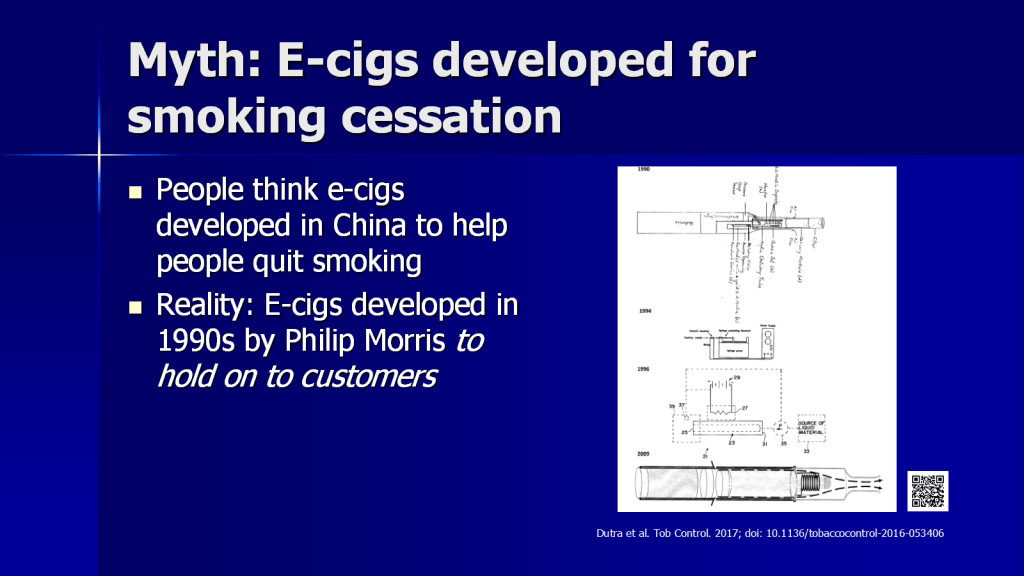
Most people think e-cigarettes were developed in China in 2003 as a smoking cessation aid.
In fact, Philip Morris had developed and patented an e-cigarette by the mid-1990s. (They did not take it to market because they were concerned that doing so would support FDA regulation of cigarettes as drug delivery devices.)
They did not develop e-cigarettes as cessation aids or to reduce harm, but to hold on to health-concerned smokers who were quitting.
(The QR codes on this slide and other link to the papers.)
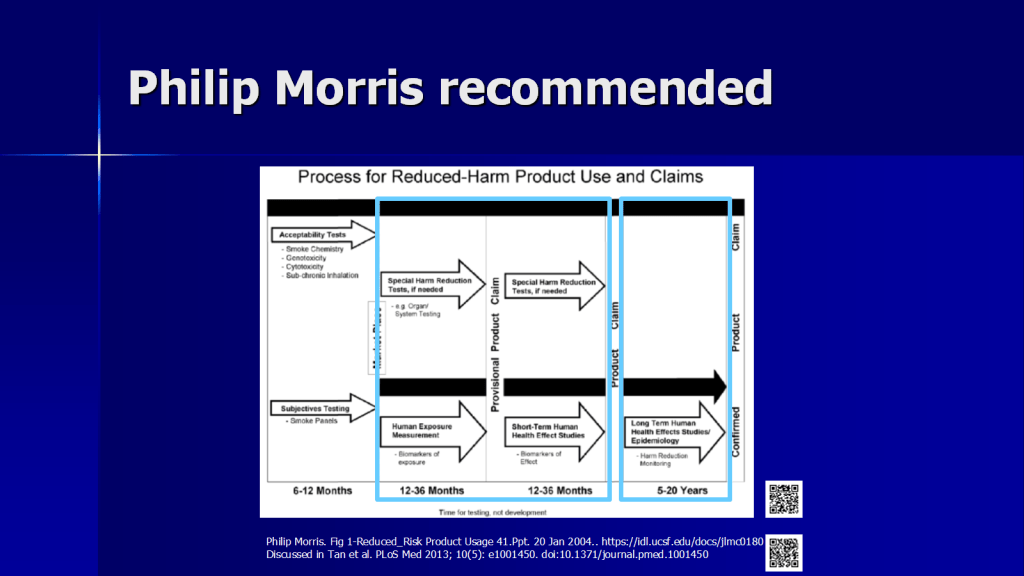
While e-cigarette advocates continue to make reduced harm claims based indirect evidence of reduced exposure to some combustion products, in 2004 Philip Morris recommended to the Institute of Medicine that after potentially reduced risk products had been on the market for 5 years direct evidence of disease from epidemiological studies was the appropriate evidence.
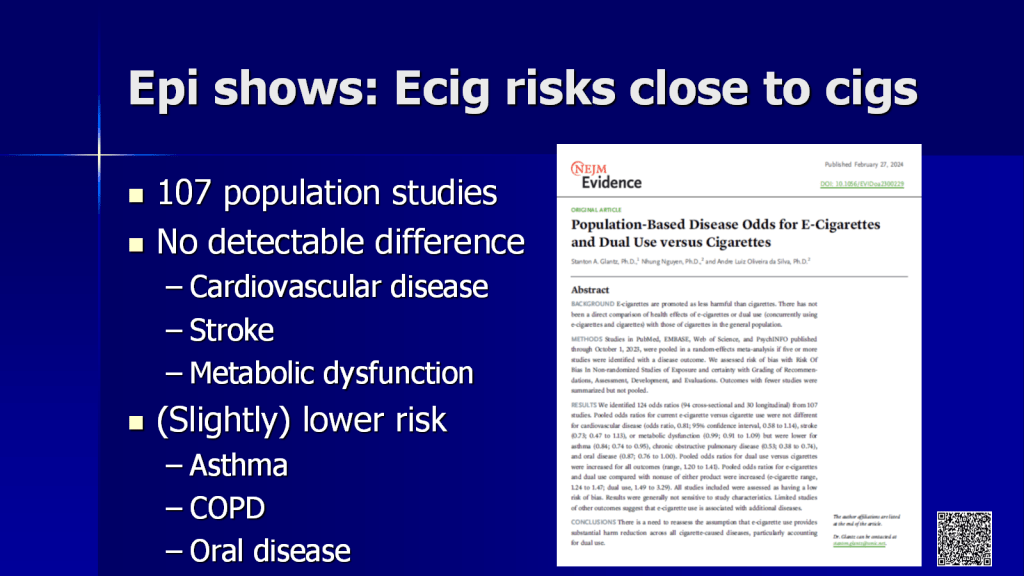
By October 2023 there were 107 such epidemiological studies. Overall, they showed similar risks to cigarettes for some diseases and, while lower than cigarettes, substantial disease risks for others.
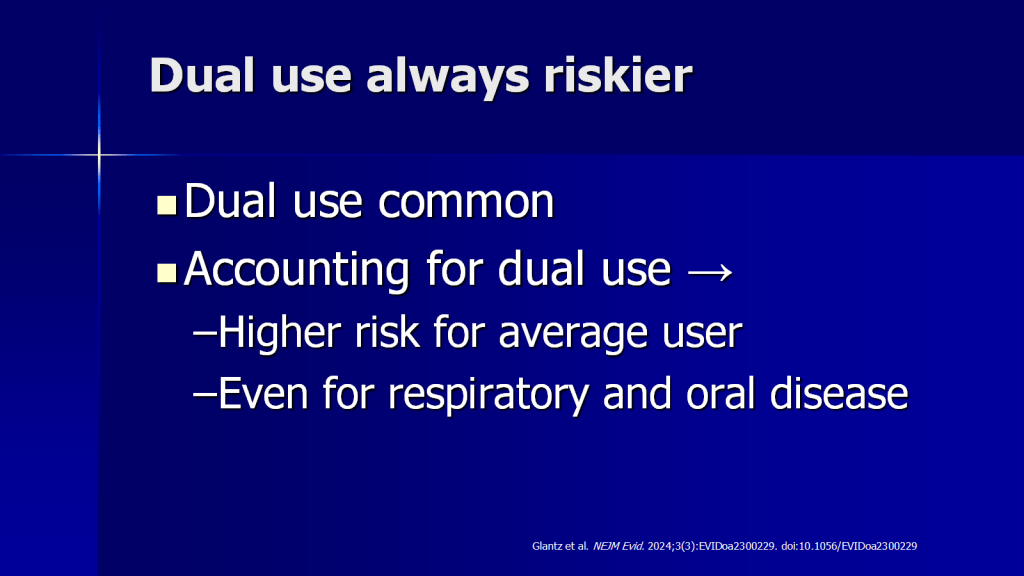
The epidemiology also shows that dual use (using both e-cigarettes and cigarettes) is risker than just smoking. This is important because many adult e-cigarette users continue to smoke cigarettes.
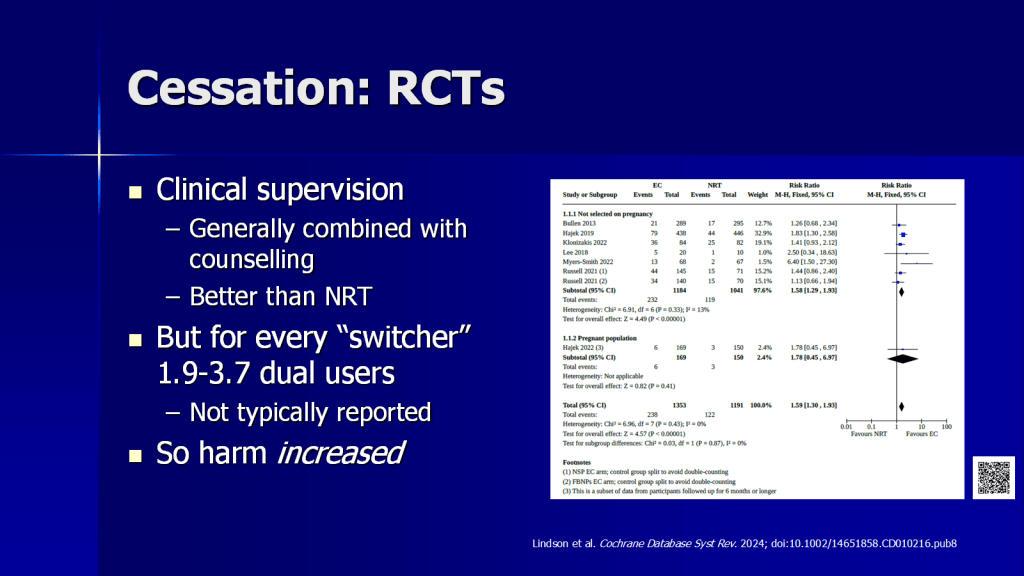
E-cigarette advocates also repeatedly point to Cochrane reviews of randomized controlled trials that show that providing free e-cigarettes (usually combined with smoking cessation counselling) is associated with stopping smoking. Digging into the individual studies, however, reveals that for every smoker who stops smoking 1.9-3.7 become dual users, increasing rather than reducing overall harm.
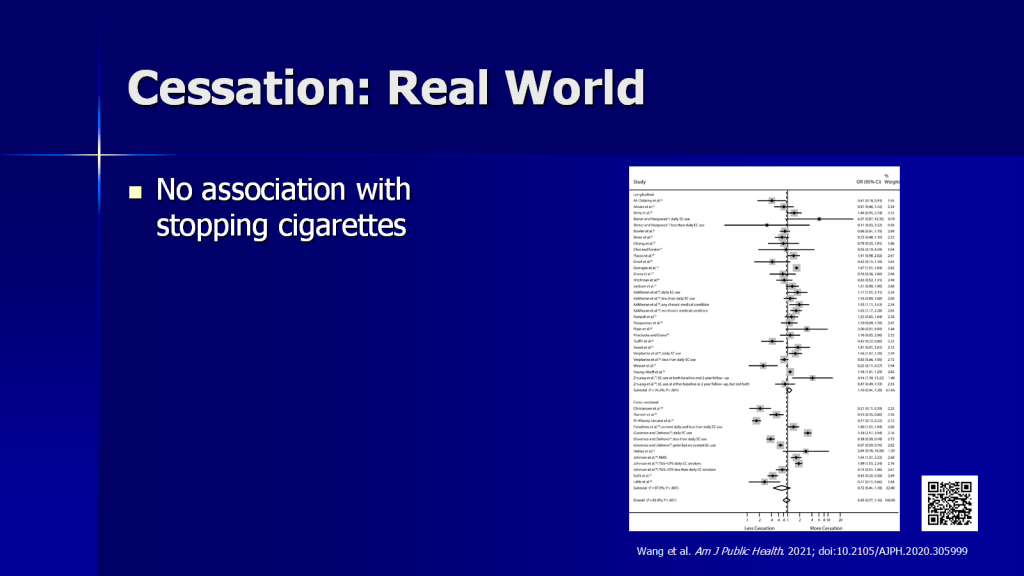
And in the real world, smokers who use e-cigarettes are, on average, no more likely to have stopped smoking than smokers who did not use e-cigarettes.
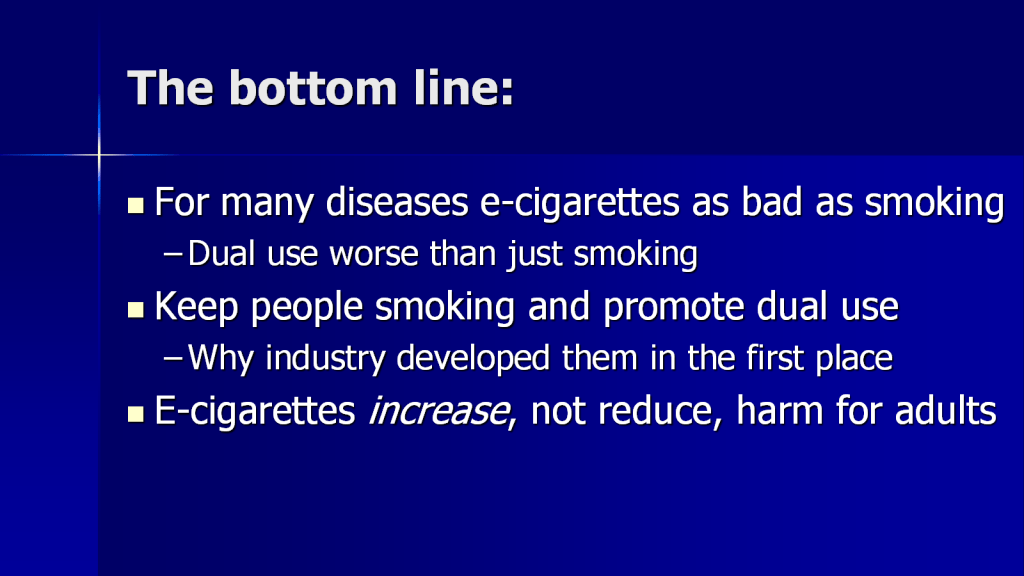
These two facts combine to demonstrate that, even at an individual level, e-cigarettes increase rather than reduce harm.
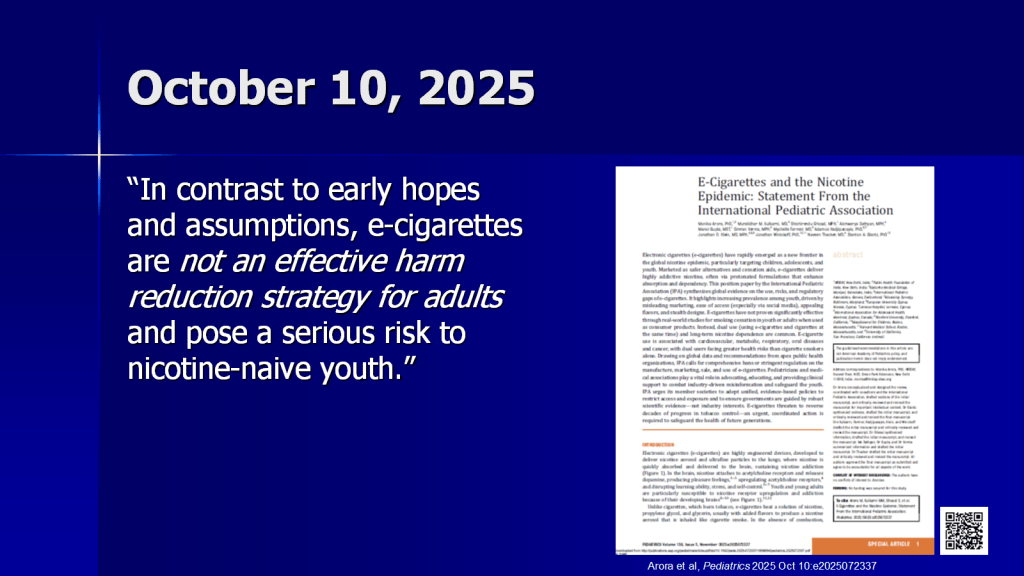
In October 2025, the International Pediatric Association published a statement summing up the evidence that e-cigarettes do not represent an effective harm reduction strategy for adults. In addition, they pose substantial risks for youth.
This report was prepared by an international committee, endorsed by the IPA Executive Committee, and published in Pediatrics after independent peer review.

The implications: Policy makers should reject tobacco industry efforts to integrate marketing of e-cigarettes into tobacco control policies.
You can download this Powerpoint presentation here or a 9 minute narrated video version here. Feel free to use all or part of them in your presentations. You can also watch the video here:
These slides are also available in 10 other languages:
 Stanton Glantz blog
Thank you for these posts. E-cig/tobacco interests are trying to infiltrate the APHA under the guise of harm reduction and I am sharing your invaluable evidence and perspectives. They never give up so I guess we can’t either!
SH
LikeLike