Stanton Glantz blog
Commentary on tobacco, cannabis and public health

Secondhand smoke pioneer Jim Repace died in April 2026
I only recently learned that Jim Repace, who laid the scientific foundation establishing that secondhand tobacco smoke exposure was widespread and serious starting in the 1970s and published the first estimate of the number of lung cancer deaths secondhand smoke caused in 1985. He played a crucial role in the development of the EPA’s landmark…
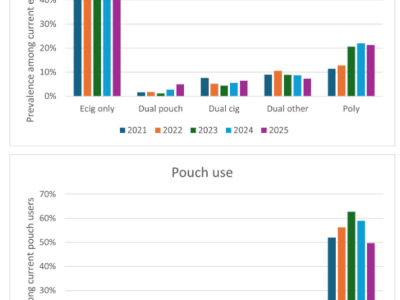
Pediatrics publishes 2025 NYTS results that highlight problems with FDA’s permissive policy toward e-cigarettes and nicotine pouches
Pediatrics just published the final version of my paper “Tobacco Use Among Middle and High School Students: 2025 National Youth Tobacco Survey.” They key observations are: Overall youth tobacco use is continuing to decline The two most commonly used products are e-cigarettes and nicotine pouches The decline in overall tobacco use is manifest across all…

UCSF Makes Internal Firearm Industry Documents Public
In 1994 when I worked with the UCSF Library to put the original collection of about 10,000 pages of internal documents from the Brown and Williamson Tobacco company on the internet, I had no idea that the project would grow not only to the Truth Tobacco Industry Documents Library that contains 20 million tobacco industry…
Some Thai e-cig use despite ban on imports and sales
Roengrudee Patanavanich, her Thai colleagues, and I just published “Patterns of e-cigarette use by sex and age in Thailand: The National Health Examination Survey 2024–2025” that provides detailed statistics on cigarette and e-cigarette use in Thailand, a country that does not allow import and sale of e-cigarettes. We found current e-cigarette use among 5.3% of…
2025 NYTS highlights problems with FDA’s permissive policy toward e-cigarettes and nicotine pouches
In April 2025, as part of its attack on the federal government’s tobacco control efforts, the Trump Administration pulled the plug on data collection for the 2025 National Youth Tobacco Survey (NYTS), a large national survey of middle and high school tobacco use the CDC — later joined by the FDA — had been running…
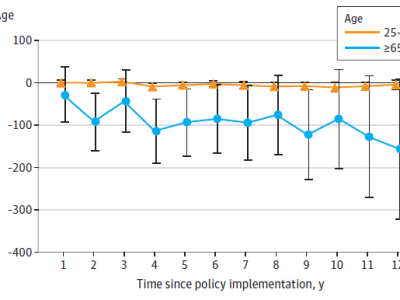
Comprehensive smoke-free laws reduce cardiovascular deaths
In 2004, when Richard Sargent, Robert Shepard and I published “Reduced incidence of admissions for myocardial infarction associated with public smoking ban: before and after study” reporting that hospital admissions for heart attacks dropped when Helena, Montana passed its smoke-free law, it was controversial. Since then, many studies have confirmed and expanded this conclusion (Institute…
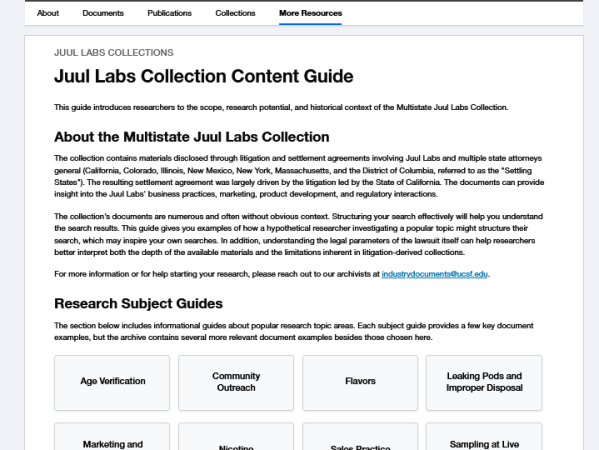
Useful guide to searching Juul documents now available
The UCSF Industry Documents Library has released a very useful new Juul Labs Collection Content Guide on the IDL website that provides a wealth of information and links to key documents to help people get started in searching the Juul documents. It is specifically built around the Multistate Juul Labs Collection, which includes materials disclosed through…

Switching from cigs to ecigs does not significantly reduce lung cancer risk
Yeon Wook Kim and colleagues’ new paper “Electronic cigarette use after smokingcessation and lung cancer risk” shows that smokers who switch to e-cigarettes have about a 50% higher risk of developing lung cancer and about a doubling of risk of dying from lung cancer than smokers who just stop smoking. Most important, this paper is…

We support FDA expanding HPHC list and suggest adding more flavoring agents (public comment)
On April; 26, 2026, FDA announced that it added 18 compounds to its “Harmful and Potentially Harmful Constituents” (HPHC) list to assess toxicity of tobacco products. This was the first update of the list since it was first released 14 years ago in 2012. The updated list includes several things, most notably propelyne glycol (PG)…
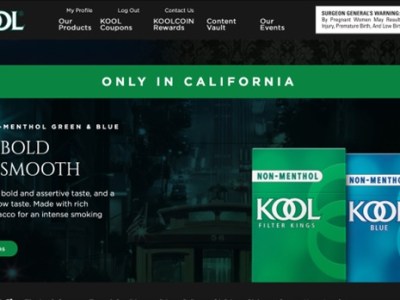
We support California’s updated”Unflavored Tobacco List” and suggest some improvements
The California Attorney Genera maintains an official “unflavored tobacco product list” to facilitate implementation and enforcement of the state’s flavored tobacco product ban. The AG proposed “readopting” an undated list. We support that proposal and made a few suggestions for improving it. A PDF is available here. This is an excellent model for other states,…
Something went wrong. Please refresh the page and/or try again.
Follow My Blog
Get new content delivered directly to your inbox.

