
Until now we have not had direct estimates of the costs of treating the excess disease that e-cigarettes cause. Now, Yingning Wang and her UCSF colleagues have published Healthcare utilisation and expenditures attributable to current e-cigarette use among US adults that applies the same well-established methods they have used to estimate the medical costs of smokingContinue reading “Ecigs increased health costs by $15.1 billion in 2018”
Category Archives: economics
Netflix documentary Big Vape is worth watching
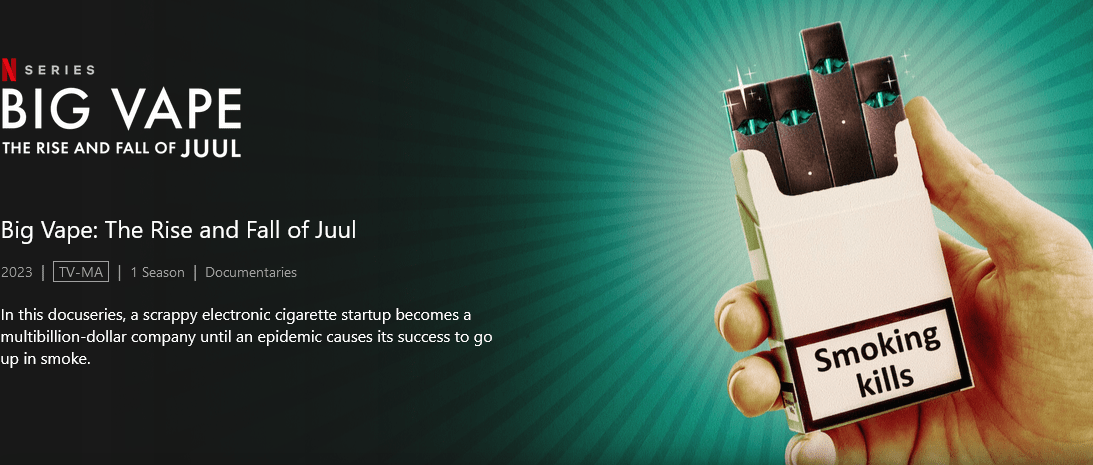
Like Jamie Ducharme’s book Big Vape, the four hour (in four episodes) Netflix documentary Big Vape tracks Juul’s development from an idea by two Stanford grad students to compete with Big Tobacco by creating a less dangerous product to replace cigarettes into part of the tobacco industry. It does a particularity good job of highlightingContinue reading “Netflix documentary Big Vape is worth watching”
UC publishes oral history of Stanton Glantz: Putting Cardiovascular, Epidemiological, Economic, Political, and Policy Research into Action at UC San Francisco and Beyond

Today the Oral History Center at the University of California Bancroft Library published an oral history of my career, which is freely available to all. Beginning in elementary school in Cleveland, Ohio, the history follows me through college and gradual school. It discusses my work to develop the emergency protocols for the Apollo 5 missionContinue reading “UC publishes oral history of Stanton Glantz: Putting Cardiovascular, Epidemiological, Economic, Political, and Policy Research into Action at UC San Francisco and Beyond”
State anti-smoking program has saved Californians over a trillion dollars in healthcare costs alone

Tobacco companies oppose tobacco control policies by arguing that anything that reduces tobacco use hurts the economy. The new paper Jim Lightwood, Steve Anderson and I just published “Smoking and healthcare expenditure reductions associated with the California Tobacco Control Program, 1989 to 2019: A predictive validation,” shows that, quite the contrary, reducing smoking saves aContinue reading “State anti-smoking program has saved Californians over a trillion dollars in healthcare costs alone”
FDA was correct in not quantifying consumer surplus in its analysis of the proposed standard for menthol in cigarettes
My colleagues at UCSF and other universities and I have submitted this comment to the FDA in response to its proposal to prohibit the use of menthol in cigarettes. A PDF of the comment is here. The Regulations.gov tracking number is l6b-h3rv-v16n. FDA was correct in not quantifying consumer surplus in its analysis of theContinue reading “FDA was correct in not quantifying consumer surplus in its analysis of the proposed standard for menthol in cigarettes”
FDA’s economic model underestimates the benefits of the proposed product standard prohibiting menthol in cigarettes, so the benefits would be even greater
My colleagues at UCSF and other universities and I have submitted this comment to the FDA in response to its proposal to prohibit the use of menthol in cigarettes. A PDF of the comment is here. The Regulations.gov tracking number is l6b-gxso-b6yq. FDA’s economic model underestimates the benefits of the proposed product standard prohibiting mentholContinue reading “FDA’s economic model underestimates the benefits of the proposed product standard prohibiting menthol in cigarettes, so the benefits would be even greater”
Louisiana health advocates used local ordinances to win smokefree casinos and bars despite industry opposition

Tanner Wakefield and I just published Securing Smokefree Laws Covering Casinos and Bars in Louisiana via Messaging, Continuous Campaigning and Health Coalitions that describes innovative campaigns that Louisiana tobacco control advocates, in collaboration with national groups developed to successfully secure smokefree casinos in New Orleans and other cities there despite fierce industry opposition. In particular,Continue reading “Louisiana health advocates used local ordinances to win smokefree casinos and bars despite industry opposition”
Study claiming SF flavor ban increased youth smoking dissolves; it is not based on any data collected after enforcing the ban

The research letter, “A Difference-in-Differences Analysis of Youth Smoking and a Ban on Sales of Flavored Tobacco Products in San Francisco, California” Abigail Friedman published in JAMA Pediatrics in May 2021 concluded that “San Francisco’s ban on flavored tobacco product sales was associated with increased smoking among minor high school students relative to other schoolContinue reading “Study claiming SF flavor ban increased youth smoking dissolves; it is not based on any data collected after enforcing the ban”
FCTC stimulated smoking bans and pictorial warnings but not tax increases or ad bans

The WHO Framework Convention on Tobacco Control (FCTC) committed Parties to, among other things, implement tobacco demand reduction measures including smokefree laws, strong health warning labels and increase tobacco taxes. Previous studies, including some of our work, have generally shown that countries followed treaty ratification by implementing at least some of these policies. Now HeikkiContinue reading “FCTC stimulated smoking bans and pictorial warnings but not tax increases or ad bans”
PMPSA’s Population Health Impact Model for IQOS underestimates the health impact of IQOS, does not adequately address new published research and information on population health impacts, and does not demonstrate benefits to individual or population health, so FDA should not issue an exposure modification MRTP order for IQOS 3

My colleagues and I at the UCSF TCORS submitted this public comment to the FDA. The Regulations.gov tracking number is kta-koyn-mf7k. A PDF is available here. PMPSA’s Population Health Impact Model for IQOS underestimates the health impact of IQOS, does not adequately address new published research and information on population health impacts, and does notContinue reading “PMPSA’s Population Health Impact Model for IQOS underestimates the health impact of IQOS, does not adequately address new published research and information on population health impacts, and does not demonstrate benefits to individual or population health, so FDA should not issue an exposure modification MRTP order for IQOS 3”
 Stanton Glantz blog