
Fenit Nirappil’s comprehensive Washington Post story How Black activists became defenders of Big Tobacco (June 21, 2024) includes the 2018 smoking gun document linking Al Sharpton the African American leader who played a key role in convincing Biden to pull FDA regulations ending menthol cigarettes and flavored cigars, as well as other African American andContinue reading “Smoking gun document ties Al Sharpton to Juul, efforts to protect menthol cigs”
Tag Archives: health
Shocking FDA TPSAC Meeting on PMI General Snus modified risk application
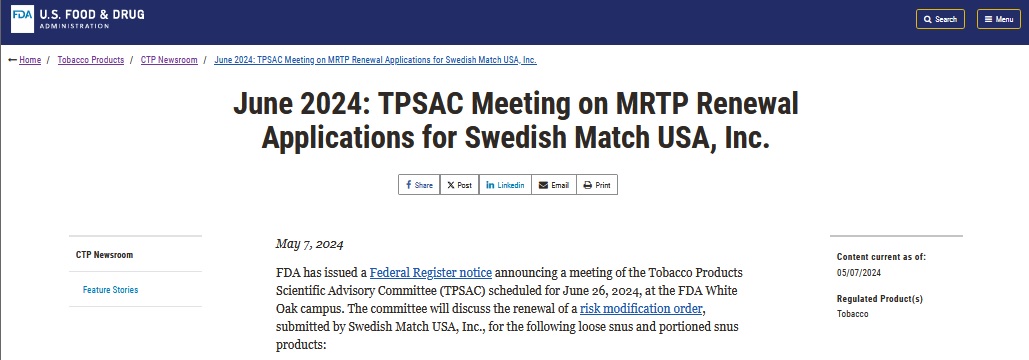
I spoke at the FDA Tobacco Products Scientific Advisory Committee meeting held yesterday (June 26, 2024) to consider Philip Morris International’s (PMI) Modified Risk Tobacco Product (MRTP) application to renew authorization to make modified (read “reduced”) risk claims about its Swedish Match General Snus. I expected the meeting to end with TPSAC voting on aContinue reading “Shocking FDA TPSAC Meeting on PMI General Snus modified risk application”
FDA should consider the significant public health issues, especially for youth, created by PMI co-marketing of its Swedish Match General Snus and ZYN oral nicotine products and not reauthorize modified risk claims for General Snus

My colleagues at UCSF and I submitted this comment to the FDA Tobacco Products Scientific Advisory Committee opposing extension of PMI’s current authorization to make modified risk claims because its co-marketing with its ZYN nicotine pouch is fundamentally misleading. TPSAC is holding a meeting to discuss the modified risk request on June 26, 2024. AContinue reading “FDA should consider the significant public health issues, especially for youth, created by PMI co-marketing of its Swedish Match General Snus and ZYN oral nicotine products and not reauthorize modified risk claims for General Snus”
FDA should not renew its authorization allowing PMI to claim modified risk for its Swedish Match General Snus

My colleagues at UCSF and Stanford and I submitted this comment to the FDA Tobacco Products Scientific Advisory Committee opposing extension of PMI’s current authorization to make modified risk claims. (The committee is holding a meeting to discuss the application on June 26, 2004.) A PDF of the comment is here. (It will be submittedContinue reading “FDA should not renew its authorization allowing PMI to claim modified risk for its Swedish Match General Snus”
Cannabis associated with bad COVID-19 outcomes, like tobacco

Many studies have shown that current and past tobacco use is associated with poorer outcomes among people infected with COVID-19. Now Nicholas Griffin and colleagues have published a large well-done study showing that cannabis use is also associated with poorer outcomes among people who have developed COVID-19. The collected data on cannabis and tobacco useContinue reading “Cannabis associated with bad COVID-19 outcomes, like tobacco”
Implications of new RCT showing similar effects on quitting for nicotine e-cigs vs varenicline

Almost all the randomized controlled trials of e-cigarettes as clinical interventions for smoking cessation have compared e-cigarettes to nicotine replacement therapy. Varenicline, which is a prescription medication that works by blocking nicotine receptors rather than replacing the nicotine that cigarettes provide, is more effective than NRT. Anna Tsiku and colleagues new paper “Electronic Cigarettes vsContinue reading “Implications of new RCT showing similar effects on quitting for nicotine e-cigs vs varenicline”
English vaping reverses nicotine decline

In England, the country that has most aggressively embraced e-cigarettes, authorities have long minimized the effects of e-cigarettes on youth and argued that they were improving public health by attracting smokers or displacing cigarette use. Now Harry Tattan-Birch and colleagues have blown those arguments away. Their May 23, 2024 paper Trends in vaping and smokingContinue reading “English vaping reverses nicotine decline”
FDA did the right thing when it withdrew its 2022 Juul marketing denial order; it should finish the job quickly by prohibiting Juul on solid grounds

On June 6, 2024, two years after the FDA issued, then suspended its Marketing Denial Order for Juul e-cigarettes based on narrow toxicology issues, FDA formally withdrew the MDO. This does not mean that the FDA has authorized Juul for sale in the US, it just lets FDA start over in its assessment of whetherContinue reading “FDA did the right thing when it withdrew its 2022 Juul marketing denial order; it should finish the job quickly by prohibiting Juul on solid grounds”
Evidence that e-cigarettes promote breast cancer

E-cigarette advocates and pro-tobacco forces generally love to point on that nicotine does not cause cancer. While they are correct that nicotine does not cause cancer, i.e., does not lead to cancer initiation, the fact is that once someone has cancer, nicotine makes it worse. In particular, nicotine promotes growth of blood vessels into tumorContinue reading “Evidence that e-cigarettes promote breast cancer”
Recording of ProfGlantz June 4 presentation “Are ecigs safer than regular cigs?” is now available
On June 4, 2004, I gave a presentation to the Clean Air Coalition of British Columbia, which includes the Heart and Stroke Foundation and the Canadian Cancer Society, entitled “Are E-Cigarettes Safer than Regular Cigarettes?” Several people asked if I a recording was available. It is. The link is https://us02web.zoom.us/rec/share/rz8sgGt3JyCFS-wWHJJE94ynyXkVsqNOjKUnxnrHsKJbhcTo-_MQDQUxf_Kl0PYf.E35DQkP5nljY9V95 Passcode: ?FCk!$3& An open accessContinue reading “Recording of ProfGlantz June 4 presentation “Are ecigs safer than regular cigs?” is now available”
 Stanton Glantz blog