The pro-cannabis advocacy group California NORML recently reported that it had successfully kept an exemption for cannabis use in the smokefree multiunit housing provision of the draft ordinance that the Oakland City Council approved on first reading on November 12, 2024. Their posting includes two inaccurate statements dismissing the cancer risks of secondhand cannabis and tobacco smoke.
Cannabis secondhand smoke
NORML cited a 2017 report National Academy of Sciences to support the claim that cannabis smoke it “doesn’t cause cancer even in first-hand users.” While that is an accurate summary of what the 2017 report said, NORML ignores the fact that the report was limited to human epidemiology data only. In contrast, the more complete Proposition 65 assessment of both active and secondhand cannabis smoke conducted by the State of California in 2009 concluded that
there is some evidence from studies in humans that marijuana smoke is associated with increased cancer risk. Studies in animals also provide some evidence that marijuana smoke induces tumors, with benign and malignant tumors observed in rats exposed via inhalation, malignant tumors in rats exposed via subcutaneous injection as newborns, and benign tumors in mice exposed dermally. Studies investigating the genotoxicity, immunotoxicity, and effects on endocrine function and cell signaling pathways provide additional evidence for the carcinogenicity of marijuana smoke. Finally, the similarities in chemical composition and in toxicological activity between marijuana smoke and tobacco smoke, and the presence of numerous carcinogens in marijuana (and tobacco) smoke, provide additional evidence of carcinogenicity. [emphasis added]
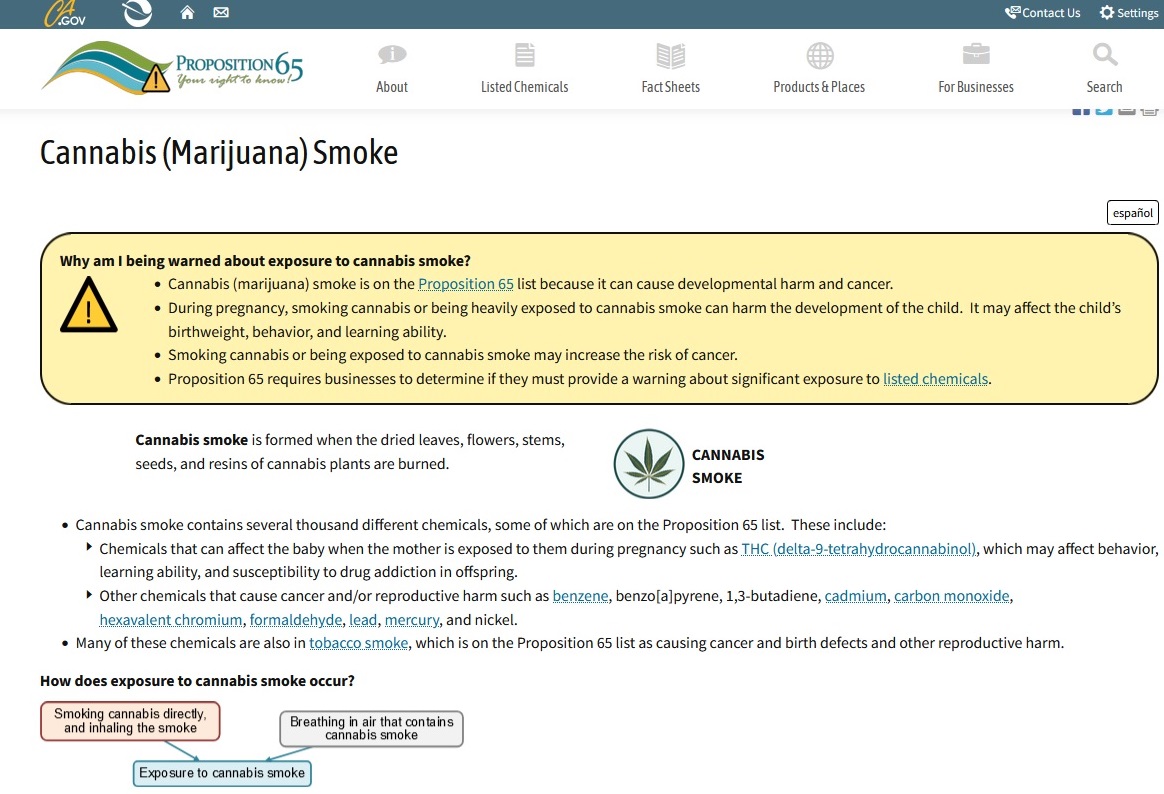
The bottom line according to the State of California:
Why am I being warned about exposure to cannabis smoke?
- Cannabis (marijuana) smoke is on the Proposition 65 list because it can cause developmental harm and cancer.
- During pregnancy, smoking cannabis or being heavily exposed to cannabis smoke can harm the development of the child. It may affect the child’s birthweight, behavior, and learning ability.
- Proposition 65 requires businesses to determine if they must provide a warning about significant exposure to listed chemicals.
Thus, the exemption leaves open the question of whether landlords will be required to warn their tenants about secondhand marijuana smoke.
Tobacco secondhand smoke
NORML also quoted a recent post to the Reason website arguing that a recent study found a negligible cancer risk from breathing secondhand tobacco smoke. This statement is surprising because the paper they cite says, “Second-hand smoke contributed an additional 6070 cases of lung cancer (2.7% of lung cancer cases).”
While the toll of secondhand smoke-caused lung cancer is well below the toll of active smoking (195,590), it is still substantial, especially if you are one of the 6070 people who get lung cancer from secondhand smoke.
The secondhand smoke toll is based on a well-established risk estimate (a 29% increase in risk due to passive smoking) from the 2006 Surgeon General report on secondhand smoke (page 435). The conclusions of the report are unequivocal:
The evidence is sufficient to infer a causal relationship between secondhand smoke exposure and lung cancer among lifetime nonsmokers. This conclusion extends to ail secondhand smoke exposure, regardless of location.
The pooled evidence indicates a 20 to 30 percent increase in risk of lung cancer from secondhand smoke exposure associated with living with a smoker. [page 445; emphasis added]
“All secondhand smoke exposure” includes bar patios and smoke drifting from other units in multiunit housing covered by the ordinance.
Incidentally, Reason has a long history of collaboration with and financing by Big Tobacco.
The bigger more immediate risk is heart disease not cancer
As I noted in my testimony at the November 12 hearing, while most people think about cancer when the issue of secondhand smoke comes up, the bigger, more immediate risks are due to adverse effects on the cardiovascular system. Risks for cannabis and tobacco smoke appear similar, independent and additive.
Next steps
The Oakland Council will hold its second vote on the ordinance on December 3. Let’s hope that they at least hold firm on making bar patios smokefree (including cannabis) and multiunit housing tobacco smoke free. Of course, there is still time to close the cannabis loophole, which will save the Council from having to spend time a year or so from now going back and closing the loophole, as Berkeley and other cites have done.
 Stanton Glantz blog