On November 12, the Oakland City Council will hold a public hearing on a proposed Oakland Smoke-Free Bar Patios and Smoke-Free Multi-Unit Housing Ordinance introduced by Councilperson Dan Kalb. The ordinance as proposed would close a loophole that allows smoking on outdoor bar patios and also make multi-unit housing tobacco smoke-free. Unfortunately, the current draft ordinance includes options to allow cannabis smoking and vaping in multi-unit housing. The Council will be debating these options at the hearing.
The local public health community has endorsed the smoke-free bar patio component while taking a strong position that the exemption of smoked and vaped cannabis in multi-unit housing must be removed. Specifically, they have informed council members that they:
- WILL NOT SUPPORT any policy option that includes an exemption for smoking or vaping of cannabis in multi-unit housing
- SUPPORT protecting the health of Oakland multi-unit housing residents from all secondhand smoke, including secondhand cannabis smoke
- SUPPORT protecting the health of Oakland bar workers and patrons through a smoke/vape-free bar patio policy
Those taking this position include:
- African American Tobacco Control Leadership Council
- Alameda County Tobacco Control Coalition
- American Lung Association
- American Cancer Society Cancer Action Network
- Americans for Nonsmokers’ Rights
- Breathe CA of the Bay Area, Golden Gate, and Central Coast
- Getting it Right from the Start
- San Mateo Tobacco Education Coalition
- Tobacco-Free Solano Coalition
I agree with the health advocates and strongly support passage of this ordinance after removing the cannabis exemption.
Both cannabis and tobacco secondhand smoke in multiiunit housing is a documented problem in Oakland
About half the complaints about smoke from other units in multi-unit housing in Oakland in 2022-2024 have been due to cannabis smoke/aerosol either alone or in combination with tobacco. (The other half are tobacco only.) It makes no sense to ignore half the problem. In addition, allowing a cannabis exemption will make the ordinance unenforceable, since if someone complains about smoke intrusion into their unit, the perpetrator could just claim they were smoking marijuana rather than tobacco.
Medical use and equity issues
It is important to emphasize that the draft ordinance does not prohibit all cannabis consumption in multi-unit housing, just inhaled consumption which pollutes the air and harms bystanders. Consumption of edibles and tinctures is not restricted.
This distinction is particularly important for people who claim that they need to be able to ingest cannabis for medical reasons. All medical forms of cannabis consumption that are approved by the FDA involve oral ingestion. As far as I know there is no good evidence that cannabis must be inhaled to achieve any demonstrated medical benefits. Indeed, oral intake is better in terms of establishing a reasonably stable level of cannabinoids in the blood, which produces the most consistent effect over time.
Equity issues are often raised when considering prohibiting inhaled marijuana in multi-unit housing. In contrast to what is often argued, Dan Orenstein’s excellent legal analysis of protecting bystanders from secondhand cannabis smoke “Multiunit Housing and Cannabis: Good Laws Make Good Neighbors” shows that because poor people are more likely to live in multi-unit housing and be subject to discriminatory enforcement of drug laws, these factors tilt the scale toward legally-mandated cannabis smoke-free multi-unit housing.
Educational resources
Several groups have provided educational materials to the Council:
LGBTQ Minus Tobacco and the Alameda County Tobacco Control Coalition has prepared an educational slideshow on smoke-free bar patios and smoke-free multi-unit housing that specifically addresses the need to include cannabis smoke and aerosol in the Oakland ordinances in order to be effective and enforceable.
Americans for Nonsmokers’ Rights has produced an excellent comprehensive fact sheet on secondhand cannabis smoke and its effects, including many citations to the scientific and medical literature.
Smoke is smoke
Except for the different psychoactive agents (THC vs nicotine), the smoke and secondhand smoke that cannabis and tobacco create is broadly similar, with some toxins higher and some lower in one or the other. Specifically, the 2007 paper “A Comparison of Mainstream and Sidestream Marijuana and Tobacco Cigarette Smoke Produced under Two Machine Smoking Conditions” found that on a per-puff basis
… the results showed qualitative similarities with some quantitative differences. In this study, ammonia was found in mainstream marijuana smoke at levels up to 20-fold greater than that found in tobacco. Hydrogen cyanide, NO, NOx, and some aromatic amines were found in marijuana smoke at concentrations 3–5 times those found in tobacco smoke. Mainstream marijuana smoke contained selected polycyclic aromatic hydrocarbons (PAHs) at concentrations lower than those found in mainstream tobacco smoke, while the reverse was the case for sidestream smoke, with PAHs [carcinogenic polycyclic aromatic hydrocarbons] present at higher concentrations in marijuana smoke. The confirmation of the presence, in both mainstream and sidestream smoke of marijuana cigarettes, of known carcinogens and other chemicals implicated in respiratory diseases is important information for public health and communication of the risk related to exposure to such materials. [emphasis added]
Actual levels of secondhand smoke present indoors, however, are much higher for cannabis products than cigarettes. The reason for this is likely because tobacco companies “puff up” (like puffed rice cereal) the tobacco in cigarettes so as to reduce the amount of tobacco per stick to lower costs and increase profits. so there is less mass of tobacco in a cigarette than in a typical joint. The amount of pollution depends on the mass burned.
The study “Measuring indoor fine particle concentrations, emission rates, and decay rates from cannabis use in a residence” reported the level of ultrafine air pollution (PM2.5, particles smaller than 2.5 µm in diameter, about 1/50 to 1/00 the size of a human hair) in a residence after smoking or vaping cannabis compared to smoking a Marlboro tobacco cigarette:
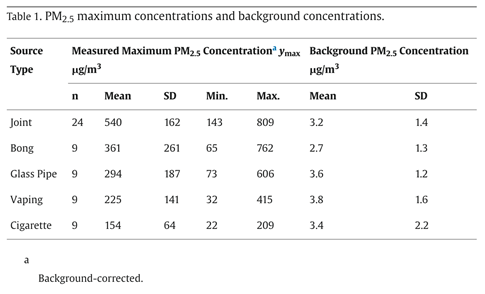
These are all very high levels of pollution. The National Ambient Air Quality Standard for PM2.5 (annual average) is 9 µg/m3; the California standard is 12.
These particles are very dangerous. Just one minute of marijuana secondhand smoke inhibits normal functioning of arteries. (Other forms of consuming marijuana has similar effects but does not pollute the air and harm bystanders elsewhere in the building.) Ultrafine particles also increase the risks of heart attacks, strokes, respiratory problems and other diseases. These effects are not all that different from the effects of PM2.5 due to diesel exhaust, forest fires and other combustion of organic material. (The California Air Resources Board has a good summary of the effects and regulation of PM2.5.)
It has been argued that perhaps cannabis smoking could be prohibited while allowing vaping cannabis because vaping does not produce as much pollution per puff consumed as smoking. Vaping does produce less secondhand air pollution (see table above) than smoking because unlike a cigarette or a joint which smolders when not being puffed (and so pollutes the air with sidestream smoke as well as the exhaled mainstream smoke), vapes do not smolder when not being puffed, so they only produce exhaled mainstream smoke. Indeed, the table shows this (mean PM2.5 for joint is 540 µg/m3) compared to 225 for vaping). But the 225 for vaping cannabis is still higher than the Marlboro cigarette. More important, even vaping cannabis produces PM2.5 levels 25 times what is considered acceptable.
Also, note that this study was conducted in a highly controlled environment. In the real world where people might be consuming cannabis (or nicotine) faster, or where there are multiple users, the pollution levels will be even higher.
For more information, see my blog posts on this and another study (of bongs):
- Marijuana joints produce 3.5 times as much secondhand smoke as a Marlboro; cannabis vapes also produce more pollution than a Marlboro
- Marijuana bong produces huge amounts of secondhand smoke
The bottom line: It makes no sense to exempt smoked or vaped cannabis from the ordinance.
What about cancer?
While there is not yet evidence that secondhand marijuana smoke causes cancer, as noted above, it does include carcinogens (chemicals that cause cancer). In addition, there are many studies linking active smoking of cannabis to cancer, including:
- Cannabis and Cancer | Cannabis and Public Health | CDC
- Cannabis exposure and risk of testicular cancer: a systematic review and meta-analysis
- Cannabis use and incidence of testicular cancer: a 42-year follow-up of Swedish men between 1970 and 2011
- Association Between Marijuana Use and Risk of Cancer
Economics
While it hasn’t come up in the public discussion yet, it is possible that opposition to the smoke-free bar patio provision will claim that it will hurt the bar business. This a myth that Big Tobacco has promoted through restaurants and bars for decades. In fact, we did the first study (published way back in 1997) showing that smokefree laws did not affect bar revenues. (Many other studies have found the same thing since then.) In a later study, we found that bars in smokefree cities were more profitable than in cities that allowed smoking.
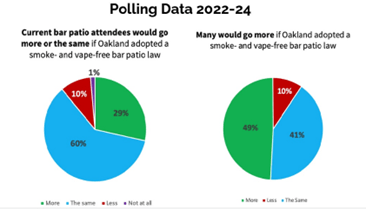
Surveys in Oakland reported in the LGBTQ Minus Tobacco and the Alameda County Tobacco Control Coalition’s slideshow (slide 14) provided consistent local results: Patrons would not change their behavior if patios were smoke-free or they would go to bars with patios more often.
Hearing details
TUESDAY, NOVEMBER 12 – OAKLAND CONCURRENT MEETING OF THE OAKLAND REDEVELOPMENT SUCCESSOR AGENCY AND THE CITY COUNCIL
WHAT: In-Person Public Comment on Oakland Smoke-Free Bar Patios and SFMUH Ordinance Agenda Item 8: No-Smoking Ordinance. (In-Person attendees will need to submit a speaker card to the clerk by 4:00pm. If you wish to speak, but cannot arrive until later please send an email with your full name to jimmy@lgbtqminustobacco.org , and a card will be submitted for you).
Can’t attend in-person but can attend virtually? Give your public comment online by signing up for a “Speak Up, Oakland” account and registering to speak on Agenda Item 8: No-Smoking Ordinance. To sign up for a “Speak Up, Oakland” account in order to make eComment, please click here. Virtual attendees must submit an eComment card HERE before Monday 3:30pm, on November 11th.
WHEN: Tuesday, November 12, 2024 – meeting starts at 3:30 p.m. (The item will likely begin at around 5:00pm but could start earlier. To receive a text or email when the item begins, contact jimmy@lgbtqminustobacco.org)
WHERE: Oakland City Council Chambers, 1 Frank Ogawa Plaza, 3rd Floor
Click here for the Agenda of the November 12th meeting
Click here for a Smoke-Free Bar Patios Public Comment Participation Guide with Sample Speaking Points
Click here for an FAQ regarding SFMUH Policy
Click here for SFMUH Sample Speaker Points
Interested in submitting a Letter of Support from your organization? Click here for the Letter of Support template regarding smoke-free policies in Oakland. Please send your letters of support to: council@oaklandca.gov; cityclerk@oaklandca.gov; officeofthemayor@oaklandca.gov and bcc the Alameda County Tobacco Control Coalition at actobaccofree@gmail.com


This report says the ordinance passed the first reading: bar patios would become smokefree, but the cannabis exemption for smoking and e-cigs in apartments.
https://archive.org/details/KRON_20241113_140000_KRON_4_News_at_6am
LikeLike