
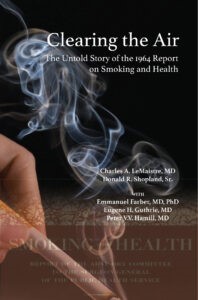
The 1964 Report on Smoking and Health represented a turning point in the history of tobacco in the United States and the world. Now Don Shopland [photo above], who at the time was an eighteen year-old, “newly working at the National Library of Medicine,” who found himself moonlighting for the Surgeon General’s Advisory Committee that prepared the report, photocopying scientific articles for the committee, just published a detailed history of the committee’s deliberations that led the the report.
The book, Clearing the Air: The Untold Story of the 1964 Report on Smoking and Health, uses working papers and other unpublished materials to provide a detailed behind-the-scenes account of how the report was produced. (He was later assigned to work full-time with the committee, a position he held through completion of the report.) As someone who has sat on similar scientific committees and grappled with issues of causality and when you know enough to draw conclusions, I found the detailed deliberations engrossing.
For people who are not as interested in the guts of scientific decision making under pressure, Part I of the book, which deals with the decision to create the Surgeon General’s Advisory Committee and the selection of its members, and Parts VI (The End of the Medical and Scientific Controversy) and VII (Retribution) on the industry’s response working through its political allies, including downgrading the authority of the Surgeon General, will still be of interest to broad audiences. Part VIII (A Smoke-Free Society) contains interesting comments on where we are now from someone with decades of behind-the scenes experience in tobacco control.
I reviewed a nearly-final draft for Don and found it a real page turner.
You can buy a hard copy here. The book is also available as a free download as a PDF here.
Shopland’s primary coauthor, Charles A. LeMaistre, was a member of the Surgeon General’s Advisory Committee, as were contributors Emmanuel Farber, Eugene H. Guthrie, and Peter V.V. Hamill. As time passed, the responsibility fell on Don to finish the project.


Dear Stan
Thank you so much!
This is an excellent narrative. It provides further valuable detailed evidence on the tobacco industry “playbook” tactics from the 1960s onwards.
Tactics, which as you know, have since also been used by almost every other industry profiting from harmful products or practices (asbestos, firearms, gambling etc etc)
Very Best Wishes
[1611840141226]
Simon Capewell MD DSc Vice Chair, ASH Scotland
Emeritus Professor Department of Public Health, Policy & Systems, Institute of Population Health, University of Liverpool, LIVERPOOL, L69 3GB United Kingdom
Telephone: 0790 801 6477 Email: capewell@liverpool.ac.ukcapewell@liverpool.ac.uk
Twitter: @SimonCapewell99
Website: https://www.liverpool.ac.uk/population-health-sciences/staff/simon-capewell/
Society for Social Medicine & Population Health Our Liverpool, Exeter & Newcastle Conferences were brilliant
Now get ready for #SSM2024 ! Glasgow 4-6 Sept 2024 https://socsocmed.org.uk/
and check out World Public Health Nutrition Association: WPHN Congress 2024, London Monday 10 Thursday 13 June 2024 “Questioning the Solutions: Has the Decade of Nutrition delivered?”
Register now!
https://web-eur.cvent.com/event/6be91456-4a49-4a73-9acc-08ee203a9746/summary
I’m enjoying retirement; so, my apologies if my email replies are sometimes a bit slow
LikeLike
I read the paper backed Surgeon General’s report in 1964 while traveling to LA for American Cancer Society conference. At the time of my reading I was told it was “embargoed” until the official release. In 1997 I received a call from Mitch McConnell’s wife asking if I would join her and her husband for dinner when I was in Washington. Of course I said yes, after all I had been trying for months to see him about tobacco legislation. At the dinner the minority leader of the Senate promised if the health organizations would back off for 6 months he and Senator Joe Lieberman would deliver what the health agencies wanted. I was scheduled to see Lieberman the next day and at that time he confirmed what McConnell had said at dinner the night before. Six months later legislation passed. In 1998 I was appointed a member of the committee created by Congress to review the settlement. We gave it our stamp of approval. Later my wife told me what Stan Glantz would have told me if I had asked. My wife said we had been snookered by McConnell, meaning the settlement should have been stronger.
Dudley Hafner, former CEO of the American Heart Association
dudleyhafner3@gmail.com
LikeLike