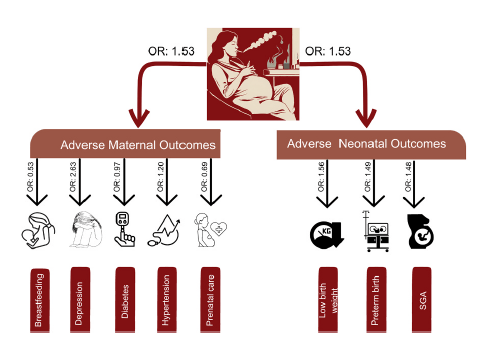
At a time when England is still encouraging pregnant women who smoke to switch to e-cigarettes, the evidence that e-cigarettes complicate pregnancy continues to grow. The recent meta-analysis “Associations between vaping during pregnancy and perinatal outcomes: A systematic review and meta-analysis” pooled the results of 25 studies published as of July 2024 and found aboutContinue reading “E-cigarette use during pregnancy increases risk for material and newborn problems”
Category Archives: vaping
20 state attorneys general sue to block HHS cuts

Today (May 5, 2025) 20 Democratic state attorneys general filed a lawsuit to reverse President Trump and HHS Secretary Robert Kennedy Jr’s devastating cuts to the Department of Health and Human Services. The suit details the broad damage that the cuts are doing, with and emphasis on the states and, in many cases, the specificContinue reading “20 state attorneys general sue to block HHS cuts”
18 Senators write HHS leaders asking for details on cuts to tobacco programs and specific plans to meet legal obligations

On April 22, 2025, 18 Democratic senators wrote HHS Secretary Kennedy and the leaders of the FDA and CDC expressing concern about Trump Administration decisions to decapitate and cut the FDA Center for Tobacco Products and shut down the CDC Office on Smoking and Health, actions that will cost billions in health costs by nextContinue reading “18 Senators write HHS leaders asking for details on cuts to tobacco programs and specific plans to meet legal obligations”
Trump gives Big Tobacco a big gift: He killed the National Youth Tobacco Survey, blinding public, researchers, and policy makers to the effects of changing tobacco industry products and practices

The now-shuttered CDC Office on Smoking and Health (OSH) has conducted the National Youth Tobacco Survey since 1999. The survey provides important surveillance about how youth tobacco use is changing. After Congress created the FDA Center for Tobacco Products, it partnered with CDC to expand the scope and depth of the survey, including increasing detailsContinue reading “Trump gives Big Tobacco a big gift: He killed the National Youth Tobacco Survey, blinding public, researchers, and policy makers to the effects of changing tobacco industry products and practices”
Shuttering CDC and FDA tobacco offices will increase the deficit by billions of dollars (right away)

Trump shuttering the CDC Office on Smoking and Heath and decapitating the FDA Center for Tobacco Products will not only increase tobacco-caused disease but will also make the federal budget deficit worse (and cost American people and businesses a lot of money in avoidable medical costs). The only winners will be the big tobacco companiesContinue reading “Shuttering CDC and FDA tobacco offices will increase the deficit by billions of dollars (right away)”
Three year study finds that fourth-generation e-cigarettes like Juul associated with continued smoking and vaping

Most studies of the association between e-cigarette use and smoking and nicotine cessation have been conducted with the earlier generation e-cigarettes, which do not deliver nicotine as effectively as the fourth generation e-cigarettes pioneered by Juul. (These e-cigarettes use protonated nicotine [also called nicotine salts] to increase nicotine delivery to the user.) Our meta-analysis ofContinue reading “Three year study finds that fourth-generation e-cigarettes like Juul associated with continued smoking and vaping”
Surgeon General Reports on Tobacco Health Disparities and E-cigs available at UCSF Tobacco Center eScholarship site

Shortly after Donald Trump took office, the Surgeon General Reports Eliminating Tobacco-Related Disease and Death: Addressing Disparities (2024) and E-cigarette Use Among Youth and Young Adults (2016), together with related public education materials, disappeared from the CDC website. As of today (February 24, 2025), the e-cigarette report was back on the CDC website, but theContinue reading “Surgeon General Reports on Tobacco Health Disparities and E-cigs available at UCSF Tobacco Center eScholarship site”
Historical and political context for Philip Morris International’s continuing medical education courses on harm reduction: Implications for current product regulation
In mid-2024 Drs. Robert Jackler, Pam Ling and others learned that the for-profit medical company Medcape was offering a continuing medical education course on tobacco harm reduction sponsored by Philip Morris International that promoted the industry position that smokers could reduce risk by switching from cigarettes to “less risky” products, such as smokeless tobacco. MostContinue reading “Historical and political context for Philip Morris International’s continuing medical education courses on harm reduction: Implications for current product regulation”
Dual use is not an intermediate condition on the way from cigarettes to “switching completely” or quitting

Discussion of potential harm reduction associated with the use of e-cigarettes assumes that smokers will “switch completely” from cigarettes to e-cigarettes or stop both tobacco products. Advocates of this view, including the US FDA, recognize and accept that this process may include a period of dual use in which smokers use both products. Now JosefContinue reading “Dual use is not an intermediate condition on the way from cigarettes to “switching completely” or quitting”
Dual cigarette and e-cig use increases human risk of lung cancer 40 times

As summarized in an earlier blog post, exposure to e-cigarette aerosol accelerates tumore growth and spread (metastasis) among established cancers. This effect is distinct from actually causing the cancer (i.e., carcinogenesis). Indeed, propylene glycol and vegetable glycerine (PG/VG), the primary solvents in e-liquid and which have been assumed to be inert are major causes ofContinue reading “Dual cigarette and e-cig use increases human risk of lung cancer 40 times”
 Stanton Glantz blog