
The whole harm reduction and reduced exposure frameworks that the FDA and others use to assess alternative inhaled tobacco products assumes that the specific details of the aerosol that these products deliver to users has a substantial effect on risks. New research by Poonam Rao, Matt Springer, and their colleagues at UCSF raises serious questionsContinue reading “A wide range of e-cigarettes similarly harm artery function as much as cigarettes”
Category Archives: vaping
High school student use of cigarettes and e-cigarettes fell after the San Francisco flavor ban took effect
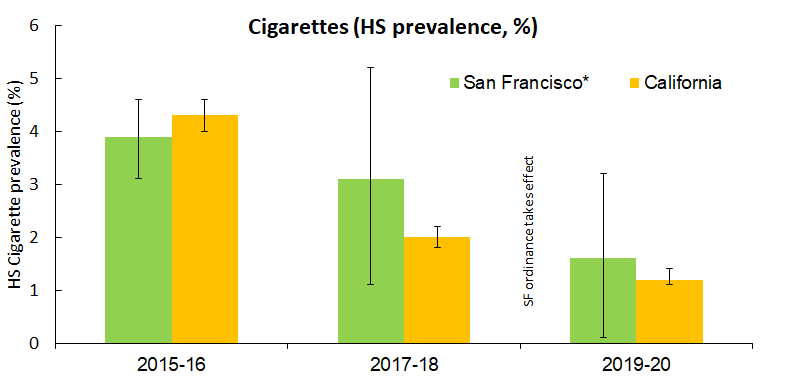
San Francisco’s experience continues to be a central issue as localities and states continue to debate legislation ending the sale of flavored tobacco products, including the tobacco companies’ effort to overturn California’s flavor ban by forcing a referendum on it. Results from the 2019-20 California Student Tobacco Survey show that that, compared to the surveyContinue reading “High school student use of cigarettes and e-cigarettes fell after the San Francisco flavor ban took effect”
e-cig users have more COVID-19 symptoms

It is well-established that smokers and former smokers who are infected with COVID-19 do worse. (How smoking affects risk of infection is still an open question.) Now, there is evidence that vaping makes COVID worse among people who are infected. David McFadden and colleagues at the Mayo Clinic have published “Symptoms COVID 19 Positive VapersContinue reading “e-cig users have more COVID-19 symptoms”
The e-cig gateway has two doors

When people talk about the “gateway effect” of e-cigarettes, they are usually referring to the first gateway: the fact that never-smoking kids who initiate nicotine use with e-cigarettes are more likely to start smoking cigarettes than youth who never try e-cigarettes. E-cig enthusiasts dismiss these studies by invoking the “common liability” theory which asserts thatContinue reading “The e-cig gateway has two doors”
The fact that daily ecig users quit more is not relevant to FDA CTP’s assessment of whether to authorize the sale of e-cigs

The new paper “Association of e-cigarette use with discontinuation of cigarette smokers among adult cigarette smokers who were initially planning to quit” in JAMA Open Network by Karin Karza and colleagues confirms that smokers who use e-cigarettes daily are more likely to quit cigarettes than those who don’t use e-cigarettes. Also consistent with earlier studies,Continue reading “The fact that daily ecig users quit more is not relevant to FDA CTP’s assessment of whether to authorize the sale of e-cigs”
Ecig enthusiasts respond to criticism that they selectively cited the science by ignoring the conclusions of the papers they do cite

In addition to the excellent paper by Samet and Barrington-Trimis the American Journal of Public Health recently published two letters to the editor — one from Wasim Maziak and one from me — criticizing the paper “Balancing consideration of the risks and benefits of e-cigarettes.” That paper argues that concerns over youth e-cigarette use needsContinue reading “Ecig enthusiasts respond to criticism that they selectively cited the science by ignoring the conclusions of the papers they do cite”
Researchers write Acting Commissioner Janet Woodcock asking FDA to withdraw marketing authorization for RJR Vuse Solo ecig

Colleagues at UCSF and Stanford and I wrote FDA Acting Commissioner Janet Woodcock raising concerns that FDA’s October 12, 2021 Marketing Granted Orders for Vuse Solo failed to substantiate its determination that authorizing the marketing of Vuse Solo will provide a net improvement to public health. In particular, FDA failed to quantify the benefits vs.Continue reading “Researchers write Acting Commissioner Janet Woodcock asking FDA to withdraw marketing authorization for RJR Vuse Solo ecig”
E-cigs: What about helping the smokers?

A lot of the discussion of e-cigarettes has been about the millions of youth who are starting nicotine addiction with them. While the tobacco companies are obvious beneficiaries of this fact, no one — not even the companies — publicly claims that this is a good thing. The goal is to “help addicted smokers quitContinue reading “E-cigs: What about helping the smokers?”
Industry easily adapts to FDA’s limited action on e-cig flavors

In response to skyrocketing youth e-cigarette use, driven largely by Juul removable pod flavored e-cigs, in January 2020, FDA said they would “prioritize enforcement” against most flavored pod e-cigs. Not surprisingly, youth and young adults have shifted to menthol and disposable flavored e-cigs that FDA is not prioritizing. Now Shivani Gaiha and her colleagues atContinue reading “Industry easily adapts to FDA’s limited action on e-cig flavors”
Philip Morris’ modified risk tobacco product application for IQOS 3 does not adequately consider new research on IQOS’s appeal to adolescents or young adults, consumer perceptions, or the likelihood that the consumers will misunderstand labeling and marketing; FDA should not issue a reduced exposure MRTP order

Philip Morris has applied for permission from FDA to make reduced exposure claims for its new IQOS 3 heated tobacco product. My colleagues and I at the UCSF TCORS have submitted a public comment opposing this request. The main thrust of the comment is a discussion of 57 papers published since 2018 that consider IQOS’sContinue reading “Philip Morris’ modified risk tobacco product application for IQOS 3 does not adequately consider new research on IQOS’s appeal to adolescents or young adults, consumer perceptions, or the likelihood that the consumers will misunderstand labeling and marketing; FDA should not issue a reduced exposure MRTP order”
 Stanton Glantz blog