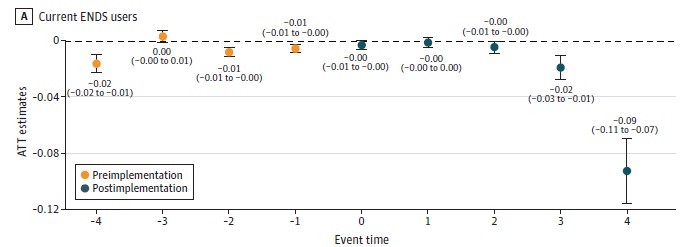
The evidence that comprehensive flavor bans are followed by drops in tobacco consumption keeps piling up. A new study by Giovanni Appolon, and colleagues, Local Flavored Tobacco Bans and Youth Electronic Nicotine Delivery Systems Use, of 2.8 million California middle and high school students across 483 local jurisdictions found that local flavored tobacco bans that took effect before California’s state ban were followed by reduced youth e-cigarette use over time. but not associated with youth cigarette use. As the graph above (from their paper shows) there were not differences in e-cigarette use in cities that later banned flavors in the years (called “event time” in the graph) before each ban took effect (event time 0), but there were reductions in e-cigarette use in cities with bans compared to cities without bans that grew over time, reaching 9.3% lower 4 years after the laws took effect. This is a huge effect.
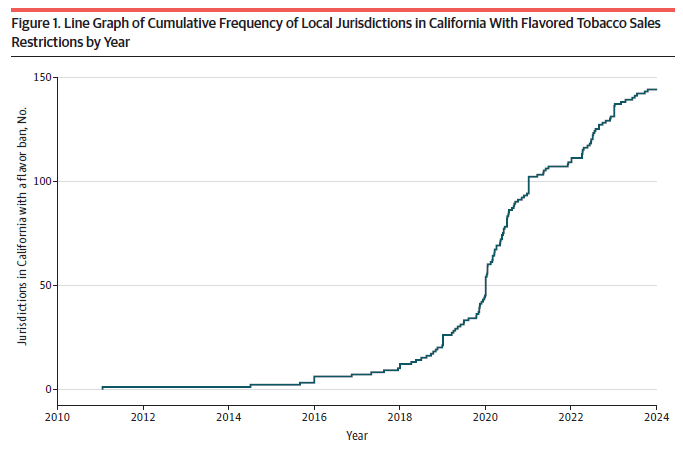
Appolon and colleagues suggest that, “[t]he delayed effects observed in years 3 and 4 for ENDS suggest that the impacts of local flavor ban policies may require multiple years to fully emerge. One possible explanation is that many jurisdictions have gradually strengthened their flavor ban policy over time, by expanding product definitions to include menthol or other flavored products or by broadening enforcement. These incremental policy updates may help explain the delayed but growing effects observed in the third and fourth years after implementation.”
Their analysis accounted for potential confounding variables, including racial and ethnic diversity, federal poverty level, and educational attainment in the communities.
They also note that their results are consistent with other studies of adults.
They also examined the association of the bans with cigarette use and did not find an association. This is not surprising given that cigarette use among youth is now very low.
Their results contrast with an earlier paper by Abigail Friedman and colleagues that found that the San Francisco flavor ban (the first comprehensive flavor ban) was associated with more smoking. The problem with the Friedman study is that the data the used were all collected before the law took effect, so their is no “after” data to actually estimate the effect of the law. In addition, it only was once city.
The bottom line: Local Flavored Tobacco Bans and Youth Electronic Nicotine Delivery Systems Use adds to the case that flavor bans reduce youth e-cigarette use.
Here is the abstract:
Importance: Although electronic nicotine delivery systems (ENDS) use is decreasing among youth in the US, the frequency of use is increasing among current users, particularly high school students.
Objective: To evaluate the effectiveness of local flavored tobacco ban policies and assess whether policies may have unintended outcomes in youth in California.
Design, setting, and participants: Repeated cross-sectional study using a confounder-adjusted dynamic difference-in-difference (DID) analysis to obtain estimates of the average treatment effect among the treated (ATT) over 6 years. Participants were middle school and high school students in the 2017-2022 California Healthy Kids Survey. Data were analyzed from February 1 to October 1, 2025.
Exposures: Policy exposure (treated group) defined as attending a school in person within a jurisdiction with an active flavored tobacco ban at the time of survey administration.
Main outcomes and measures: The primary outcome was current ENDS use, and the secondary outcome was current cigarette use. To address confounding, additional measures included racial and ethnic diversity, federal poverty level, and educational attainment, which were aggregated to the local policy jurisdiction area.
Results: Among 2 805 708 middle and high school student tobacco users, local flavored tobacco bans were associated with a reduction in current ENDS use of 2.4 percentage points (ATT, -0.024; 95% CI, -0.031 to -0.017) and were not associated with current cigarette use (ATT, 0.002; 95% CI, -0.002 to 0.005). Three years after policy implementation, ENDS use was lower in jurisdictions with flavor ban compared with jurisdictions without by 1.9 percentage points (ATT, -0.019; 95% CI, -0.027 to -0.010). Four years after policy implementation, ENDS use was lower in jurisdictions with flavor ban compared with jurisdictions without by 9.3 percentage points (ATT, -0.093; 95% CI, -0.117 to -0.069).
Conclusions and relevance: In this study, a local flavored tobacco ban policy was associated with reduced ENDS use among youth but not with cigarette use within this population. Future research should also examine trends in other states to evaluate policy adoption and enforcement.
The full citation is: Appolon G, Leas E, Pines HA, Strong D, Trinidad DR, Choi SW, Oren E. Local Flavored Tobacco Bans and Youth Electronic Nicotine Delivery Systems Use. JAMA Health Forum. 2026 Apr 3;7(4):e260631. doi: 10.1001/jamahealthforum.2026.0631. PMID: 41961492; PMCID: PMC13069452. It is available for free here.

