
Using e-cigarettes (vaping) has been promoted as a much safer alternative to smoking cigarettes. However, a new head-to-head comparison of actual disease in e-cigarette users compared to cigarette smokers published in Public Health Reports shows that this assertion is wrong.
This new analysis of 124 studies on the association of e-cigarette use with disease outcomes in the general population demonstrates that for some diseases there is no detectable difference in the odds of disease for current e-cigarette users compared to cigarette smokers. For other diseases the risks of e-cigarette use, while lower than cigarette smoking, are still much higher than what is claimed by e-cigarette advocates and assumed by the US Food and Drug Administration and others.
Specifically, the evidence as of January 1, 2025 showed that the Odds Ratios (OR) for actual diagnosed disease were not delectably different for e-cigarette users compared to cigarette smokers for metabolic dysfunction and oral disease and are lower for cardiovascular disease, stroke, asthma, COPD, and fetal growth. The odds ratios comparing e-cigarette use to smoking for cardiovascular disease (OR = 0.76), stroke (OR = 0.62), asthma (OR = 0.84), COPD (OR = 0.55), oral disease (OR = 0.89), and fetal growth (OR = 0.62 [with very low confidence]), while lower than for cigarette use, are 3 to 10 times the 15% risk that the FDA and the 5% risk that Public Health England have quoted.
The odds of disease associated with dual use (use of e-cigarettes and cigarettes), a common behavior among adults, is higher than for just smoking for all outcomes except fetal growth. This finding is important for people considering e-cigarettes as a smoking-cessation aid: other studies show that for every smoker who successfully quits with e-cigarettes 2-4 become dual users, resulting in an overall increase in disease risk compared to just continuing to smoke.
E-cigarette use among nonsmokers is also associated with increased risk for most diseases. For example, the odds of disease are increased by 24% for cardiovascular disease, 45% for COPD, and 53% for oral disease compared to nonusers.
Author Stanton Glantz, PhD, a retired UC San Francisco professor of medicine, observed, “It is long past time to use actual disease effects (as opposed to exposure to a few toxins in cigarette smoke) when assessing e-cigarettes safety. While not quite as bad as cigarettes, they are nearly as bad, which is very dangerous. Accounting for dual use, they are as bad or worse.”
Coauthor Andre Luiz Oliveira da Silva, PhD, Health Regulatory Specialist at Brazil’s Agência Nacional de Vigilância Sanitária (Brazilian Health Regulatory Agency, ANVISA) summed up the paper as indicating that “tobacco company advertisements promoting e-cigarettes to reach a future without cigarettes would likely be a future with levels of disease and death not so different from today.”
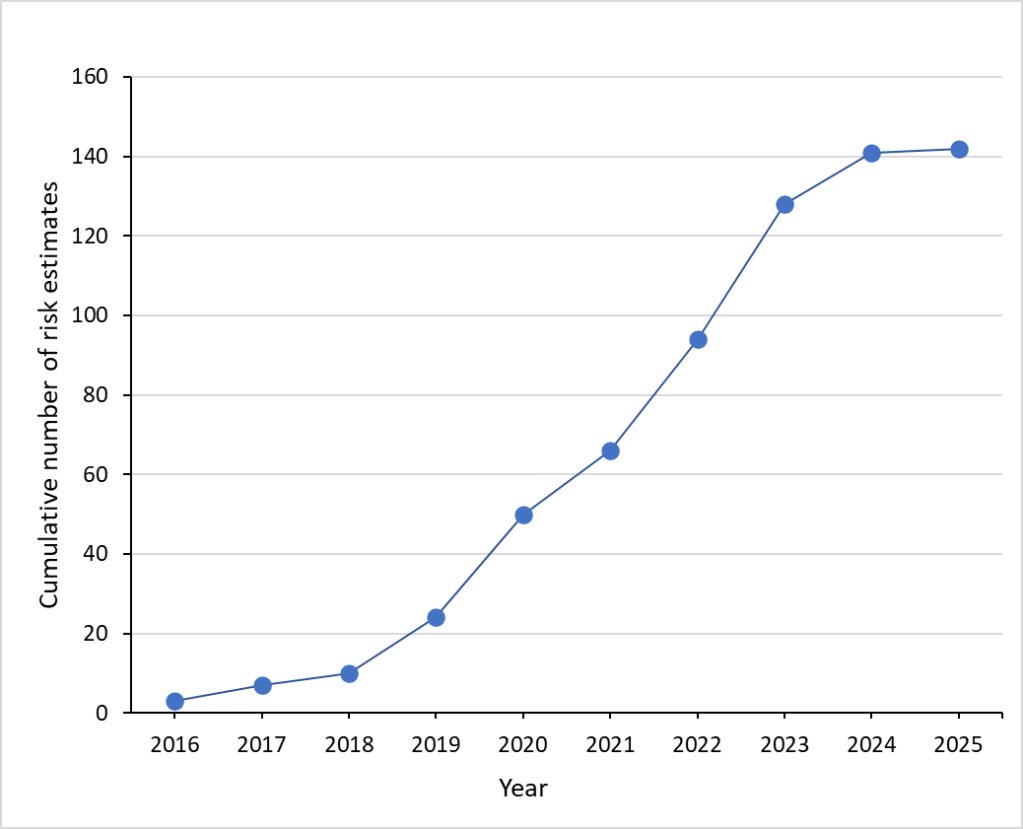
The paper notes that it is important for scientific, medical and policy making to be based on current data, noting that 81% of the studies were published during or after 2020. It closes with the recommendation that, “Health care providers and public health authorities should stop promoting e-cigarettes as a meaningfully safer alternative to cigarette smoking.”
The paper, “Comparison of e-Cigarette and Cigarette Use and Dual Use Associations with Disease: Updated Systematic Review and Meta-Analysis” (Public Health Reports 2026;0(0). doi: 10.1177/00333549251403349) updates an earlier analysis of 107 papers available as of October 2024. The new paper reaches similar conclusions, although some details changed.
Public Health Reports is the official journal of the Office of the U.S. Surgeon General and the U.S. Public Health Service published through an agreement with the Association of Schools and Programs of Public Health.
If you cannot access the paper through the links above, contact me and I will send a free copy.


Let me fix your opening paragraph, based on the results of your study.
“Using e-cigarettes (vaping) has been promoted as a much safer alternative to smoking cigarettes. However, a new head-to-head comparison of actual disease in e-cigarette users compared to cigarette smokers published in Public Health Reports shows that this assertion is CORRECT for reducing cardiovascular disease, stroke, asthma, COPD, and fetal growth.”
In fact, in your table showing e-cig vs. cigarette use, the only disease where the risk is “lower” in cigarette smokers was COVID. Two of three studies supported this claim. Yet, the two studies that did support this claim were a single-year study of the same dataset and completely ignores that smoking cigarettes is likely correlated with lower probability of seeking a COVID-19 test.
So, I fail to understand how, from the results of your own meta analysis, you can still claim that e-cigarettes provide no harm reduction over combustible cigarettes.
LikeLike
We did not draw any quantitative conclusions about e-cigarettes and COVID-19 because there were not 5 studies to pool. We simply reported the COVID-19 results for completeness.
The reason we drew the overall conclusion we did is because many e-cigarette users are dual users (i.e., continue to smoke cigarettes as well as use e-cigarettes). This point is summed up on pages 8-9 of the paper:
“The finding that, except for fetal growth (where we
have very low confidence in the results), dual use has
higher risks of disease than cigarette use alone is important
because dual use is common in the population15-18 and a
more likely outcome than “switching completely” among
people150,151 using e-cigarettes to quit smoking.150-152
Accounting for dual use means that even for diseases
where sole e-cigarette use poses lower risks than cigarette
use, the overall effect of e-cigarette use on disease burden
will be higher (eFigure 8 in the Supplement). Future population
studies and randomized controlled trials should
report results for dual use. Regulatory decisions about
whether e-cigarettes are ‘appropriate for the protection of
public health,’ the legal standard173 the FDA is required to
use, need to account for dual use. Randomized controlled
trials of e-cigarettes for smoking cessation should treat
dual use as an adverse outcome because it poses a higher
risk than cigarette use, which may lead to the conclusion
that e-cigarettes as a clinical cigarette cessation intervention
increase rather than reduce harm. In addition, as consumer
products, e-cigarettes are not associated with
increased smoking cessation,174,175 and in the long run,
they are associated with decreases in cessation and
increases in the odds of becoming a dual user.176,177
…
“E-cigarette use is associated with disease outcomes
indistinguishable from or approaching the disease outcomes
associated with cigarette use for major smoking caused
diseases. Health care providers and public health
authorities should stop promoting e-cigarettes as a meaningfully
safer alternative to cigarette smoking. Dual use,
which is common among adult e-cigarette users, is associated
with a higher risk of disease than cigarette use alone.”
LikeLike