
Jagdish Kaur from WHO and several colleagues from India’s new paper “E-cigarette use and subsequent tobacco smoking initiation: an umbrella review with Bayesian model meta-analysis” provides the most comprehensive summary of evidence that e-cigarettes promote cigarette smoking in nonsmokers available to date. They also show that e-cigarette use in former smokers promotes relapse to smoking.
Kaur and colleagues searched the literature for earlier reviews and meta-analyses of the association between e-cigarette use and subsequent smoking. They found 13 qualifying meta-analyses, extracted the results from the 31 studies that one or more of the earlier meta-analyses used and conducted a fresh analysis of these 31 studies. (They did this rather than just using the 13 meta-analysis results to avoid double counting the individual studies.
In contrast to most earlier meta-analyses, they conducted a Bayesian analysis that allowed them to take into account the probability structure of the estimates. (This approach also yielded 95% credible intervals which give the range in there is a 95% probability that the true effect size lies.)
They found four key results:
- The odds of going on to cigarette smoking among any nonsmokers who used e-cigarettes tripled (OR = 3.1; 95% credibility interval 2.56 to 3.72).
- Among adolescents, the odds were nearly tripled (OR = 2.7; 2.27 to 3.21).
- The risk of relapse in former tobacco smokers who used e-cigarettes was doubled (RR = 2.03; 1.39 to 2.96).
- E-cigarette users who had never smoked had more than twice the odds of developing an intention to smoke (OR =2.21; 1.86 to 2.61).
The last two findings are important points that have not received enough attention.
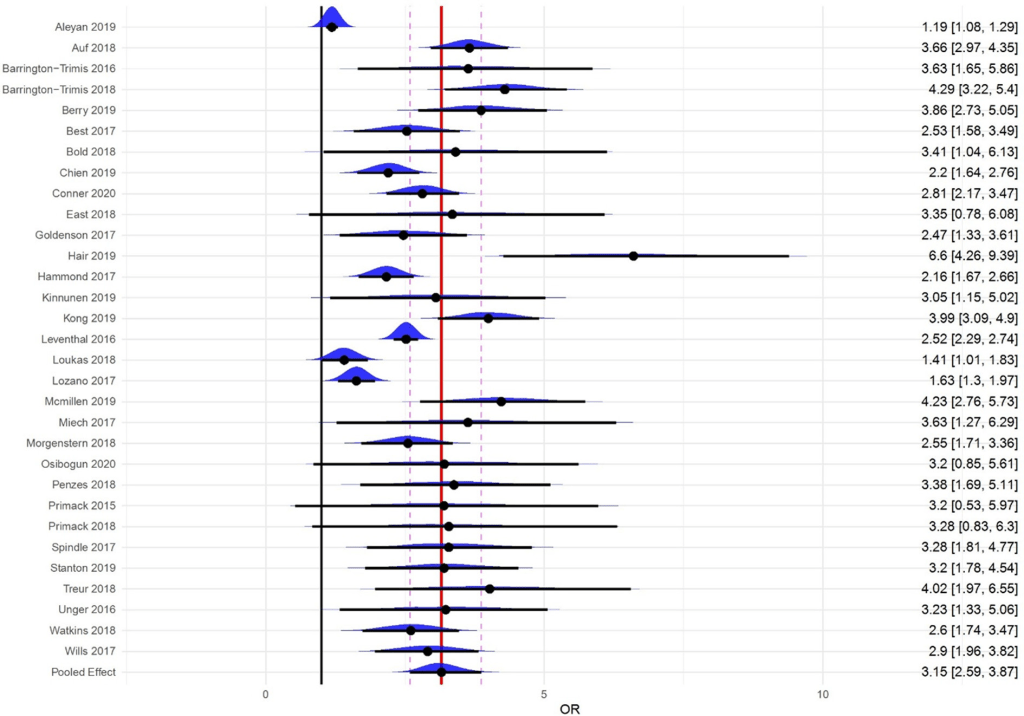
They also did a “traditional” random effects meta-analysis (the kind I use) and found similar results. The fact that one reaches the same conclusions using two different computational methods strengthens the confidence one can have in the overall conclusions.
Kaur and colleagues recognize that some have argued that these associations are an artifact of “common liabilities” in which genetic or other factor that lead to risk taking manifest as e-cigarette use and cigarette smoking. Kaur and colleagues explain why the “gateway effect” in which e-cigarette use leads to a higher probbaility of subsequent smoking is reasonable:
The gateway effect associated with the use of ENDS [electronic nicotine delivery systems, in this case e-cigarettes] can be attributed to several factors, which primarily fall into two broad categories: nicotine exposure-related and social and behaviour-related factors. First, nicotine exposure-related factors play a critical role in the gateway effect. Most ENDS contain varying concentrations of nicotine, which is a highly addictive substance. When individuals, particularly adolescents and young adults, use ENDS, they are exposed to nicotine, which can lead to nicotine dependence. This dependence on nicotine significantly increases the likelihood of transitioning from ENDS to traditional cigarettes, as users seek more potent sources of nicotine46 to satisfy their addiction Second, social and behaviour-related factors also contribute substantially to the gateway effect. The use of ENDS can normalise smoking among peers and within social circles, making the inhalation of substances more socially acceptable. This normalisation can lower the psychological and behavioural barriers to smoking, making individuals more open to experimenting with traditional cigarettes. Moreover, the marketing and promotion of ENDS, often highlighting their flavours and stylised designs, further enhances their appeal, particularly to younger demographics, and contributes to their normalisation within society.
Another important point (that they don’t make) is that proponents of the common liability theory have yet to produce any direct evidence that it is actually what is happening.
The bottom line: This paper adds to the overwhelming case that e-cigarette use promotes smoking, including relapse to smoking among former smokers.
Here is the abstract:
Objective: Electronic nicotine delivery systems (ENDS) have seen a global surge in their usage. However, their role in smoking initiation, particularly among non-smokers, remains a critical concern. This umbrella review evaluated the risk of tobacco-smoking initiation following ENDS use, focusing on non-smokers, by synthesising evidence using Bayesian meta-analysis.
Study design: Systematic review and Bayesian meta-analysis.
Methods: We searched databases including PubMed, EMBASE and Cochrane Library up to 1 May 2025. We included systematic reviews assessing tobacco-smoking initiation after ENDS use among non-smokers. Quality was evaluated using the AMSTAR-2 (A Measurement Tool to Assess Systematic Reviews – version 2). A Bayesian hierarchical meta-analysis was conducted to estimate pooled ORs with 95% credibility intervals (CrIs), using non-informative priors to model heterogeneity and uncertainty. This study was registered with PROSPERO (CRD42023464207).
Results: From 5055 records, 13 systematic reviews were included. Of them, five were rated as ‘high quality’, one as ‘moderate’, four as ‘low’ and ‘three’ as critically low, as per AMSTAR-2 quality assessment. The meta-analysis revealed a pooled median OR of 3.1 (95% CrI 2.56 to 3.72) for smoking initiation among non-smoking ENDS users, with moderate heterogeneity (τ mean: 1.23). Among adolescents, the OR was 2.7 (95% CrI 2.27 to 3.21), with moderate heterogeneity (τ mean: 0.63). The risk of relapse in former tobacco smokers who used ENDS was doubled (RR: 2.03, 95% CI 1.39 to 2.96). Individuals who had never smoked but engaged with ENDS had more than twice the odds of developing an intention to smoke, with an OR of 2.21 (95% CI 1.86 to 2.61). The overall certainty of the evidence was rated very low due to the risk of bias in the studies and evidence of publication bias across the studies.
Conclusions: ENDS use is significantly associated with increased risk of tobacco smoking initiation among non-smokers, particularly adolescents, supporting the gateway hypothesis. These findings indicate the need for stringent regulatory and public health strategies to protect people from nicotine addiction.
The full citation is: Kaur J, Goel S, Shabil M, Gupta S, Rana RK, Rinkoo AV, Chauhan A. E-cigarette use and subsequent tobacco smoking initiation: an umbrella review with Bayesian model meta-analysis. Tob Control. 2026 Feb 26:tc-2025-059783. doi: 10.1136/tc-2025-059783. Epub ahead of print. PMID: 41748427. It is available here.

