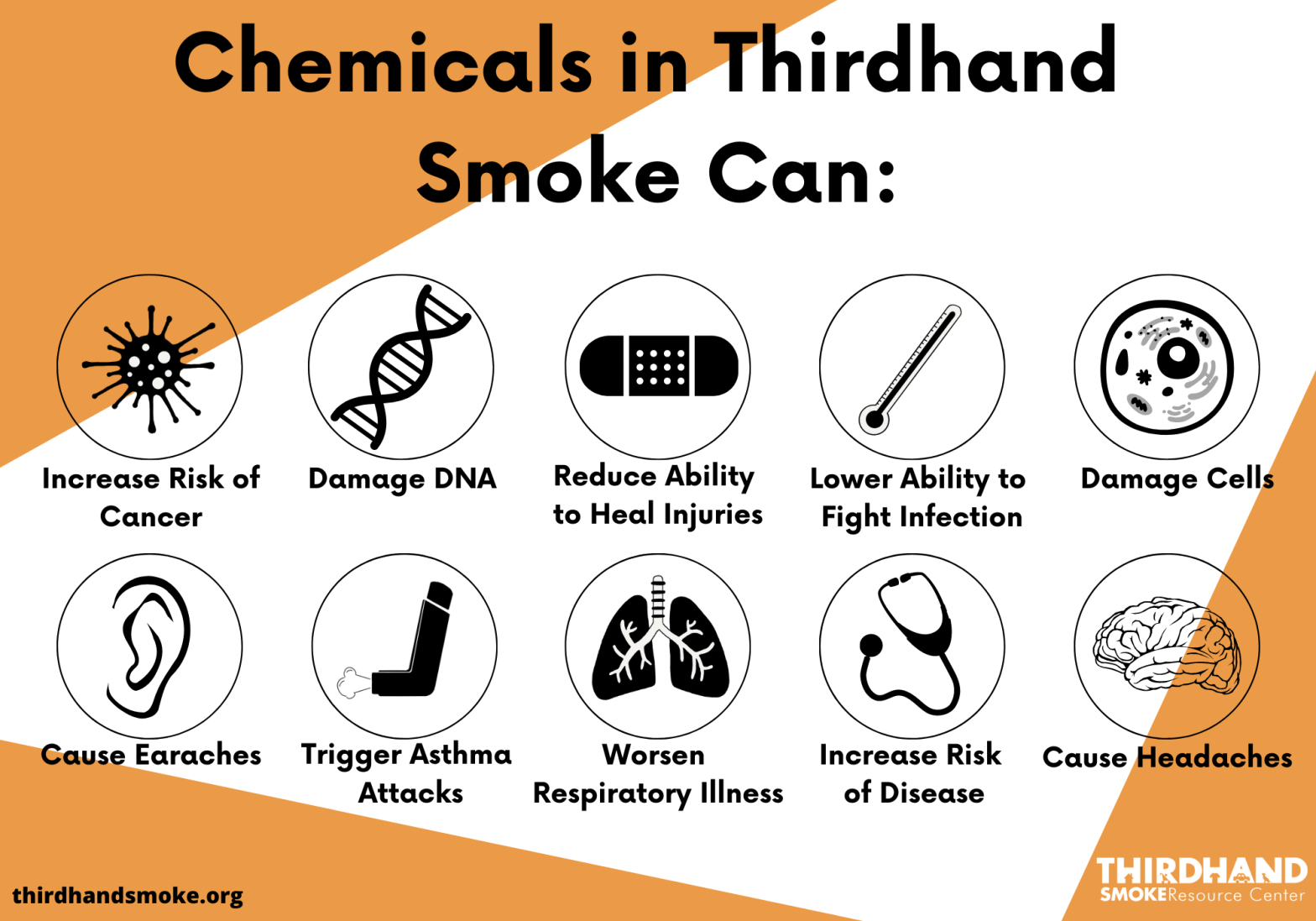
California has enacted the first law, AB455, that requires sellers of single-family homes to disclose in writing any known indoor smoking, vaping, or thirdhand smoke contamination to prospective buyers. It also also directs the California Department of Toxic Substances Control to update its Homeowner’s Guide to Environmental Hazards to include thirdhand smoke information, a task assigned to San Diego State University’s Center for Tobacco and the Environment.
Thirdhand smoke refers to the toxic residues left behind when tobacco smoke or vaping aerosols settle on surfaces, dust, and building materials. These pollutants – many classified under California’s Proposition 65 as carcinogens or reproductive toxins – can persist for years and pose particular risks to children, the elderly, and immunocompromised individuals. They are very hard to remove. AB 455 classifies thirdhand smoke as an environmental hazard comparable to asbestos, radon, or lead paint.
By classifying thirdhand smoke as a recognized environmental hazard, AB 455 sets a precedent that could influence housing, consumer protection, and tobacco policies nationwide.
This law is the culmination of decades of research leadership by SDSU Professor George Matt who pioneered research in this area and the California Tobacco Related Research Program that has supported the Thirdhand Smoke Resource Center that Dr. Matt directs. (The Center has excellent educational materials on its website, including the graphic above.)
Like other adverse effects of smoking, Philip Morris conducted the first research showing that thirdhand smoke exposed people to toxins way back in 1991. As summarized in a paper by Adam Whitlatch and Suzaynn Schick:
In 1991, scientists at Philip Morris Inc conducted some of the first studies on thirdhand cigarette smoke. For 110 days, 8 hours a day, they ran sidestream cigarette smoke through a 30 m3 room that contained carpet, curtain, and textured wallpaper. The room was ventilated with clean air every night. By comparing the chemicals in the air during the 8-hour smoking period and during the clean air ventilation period, they showed that some smoke chemicals persist in the air 12 hours after smoking. By extracting the nicotine and nitrosamines from samples of the carpet, curtain, and wallpaper, they found that high concentrations of nicotine and the carcinogen 4-(methylnitrosamino)-1-(3-pyridyl)-1-butanone (NNK) persisted in the room for more than 50 days; that surface chemistry affected nitrosamine concentrations; and that the concentration of NNK in the room, 110 days after the last cigarette was extinguished, could exceed the mass of NNK that entered the room as smoke.
Significantly, the law identifies indoor vaping as another source of thirdhand exposure.
JAMA published an article by Matt and Neal Benowitz summarizing the law and its implications.
 Stanton Glantz blog
Very valuable. It adds to the already existing efforts to oppose smoking. Thank you, Dr Grantz–always look forward to anything coming from you–as it is always a step forward to strengthen our resolve. mira
LikeLike