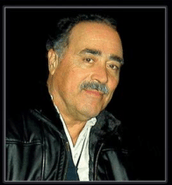
I only recently learned that Jim Repace, who laid the scientific foundation establishing that secondhand tobacco smoke exposure was widespread and serious starting in the 1970s and published the first estimate of the number of lung cancer deaths secondhand smoke caused in 1985. He played a crucial role in the development of the EPA’s landmark 1992 report Respiratory Health Effects of Passive Smoking: Lung Cancer and Other Disorders that firmly established tobacco smoke as an environmental problem, which totally transformed the debate. It is impossible to overstate how important this and Jim’s other work has been
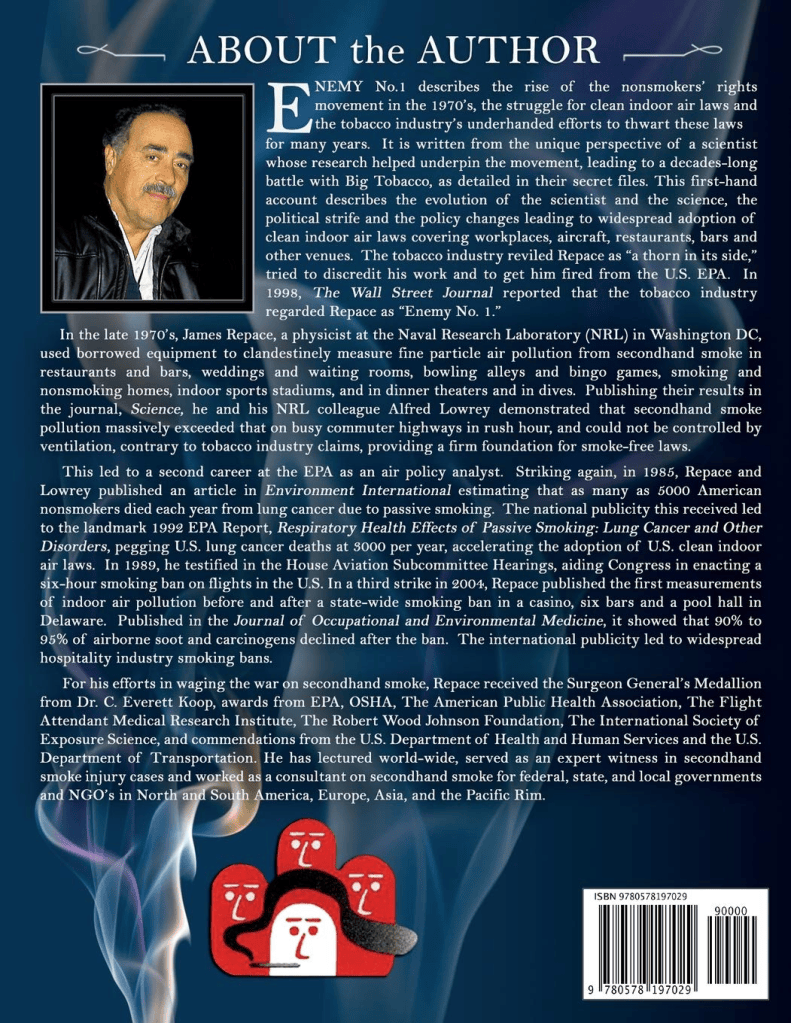
These, and many other accomplishments — and the tobacco industry’s massive (and unsuccessful) effort to shut him down — are detailed in his memoir Enemy No. 1, which is available for free on Kindle or purchase as a book.
Jim’s About the Author” second of the book provides a succinct summary of his story:
Jim continued to be active after he retired from the EPA in 1998, continuing to research and publish with several universities and serving as an expert witness in legislative debates and secondhand smoke until shortly before he died. He was particularly active in issues around casinos and, in recent years, secondhand marijuana smoke. A mutual colleague told me, “One of Jim’s last projects was a case of an inmate at a NY Correctional Facility about exposure to secondhand smoke at levels I had not seen outside of an experimental smoking chamber. Jim’s testimony/expert report is already in evidence.”
He took particular pride in being mentioned in the tobacco industry documents (27,392 times as of October 15, 2026).
Looking though Enemy No. 1 to prepare this post impressed me with the level of detail about the science and politics of Jim’s career. It both describes how the science evolved and the nuts and bolts of fighting of the industry’s efforts to stop and discredit the work. As someone who was lucky enough to become a friend and colleague, rereading it brought back many memories. There are many lessons for young public health scientists today.
Jim also had a big effect on my personal life. Shortly after I first met him, my wife and I were thinking about having a third child. I called him up and told him what we were thinking about, hat I had heard he had more than two kids, and asked for his feedback. He told me, “Hilarine and I had the same conversation, then had triplets, who were then three 16 year old boys who were destroying their house.” We went to Australia instead.
(All Jim and Hilarine’s kids grew up just fine.)
I also had the chance to visit his house in Maryland and go out on Chesapeake Bay on his beloved boat.
He is survived by his wife, Hilarine, his children, Justine, Max, Nick, Paul, Alex and Jon, and his grandchildren, Charles, Shelby, and Joseph. In lieu of flowers, donations may be made to the American Lung Association.

