In 1994 when I worked with the UCSF Library to put the original collection of about 10,000 pages of internal documents from the Brown and Williamson Tobacco company on the internet, I had no idea that the project would grow not only to the Truth Tobacco Industry Documents Library that contains 20 million tobacco industry documents, but the much larger UCSF Industry Documents Library that collects, preserves, and provides free public access to internal documents from other industries that affect public health, including opioid, chemical, drug, fossil fuel, and food industries.
On August 19, 2026 the IDL expanded again, this time into firearms, by making public 694 internal firearms documents from a Midwest retailer as part of the Minnesota Attorney General’s lawsuit alleging the company ignored an internal warning before selling firearms to a straw buyer.
Like Minnesota’s leading role in making tobacco industry documents obtained in discovery in its groundbreaking lawsuit against tobacco companies back in the 1990s, this the first state-led settlement to include the public release of internal firearms industry documents. Since then, attorneys general have plays a key role in forcing internal industry documents into the open, not only in many tobacco settlements, but, more recently, millions of pages of opioid documents.
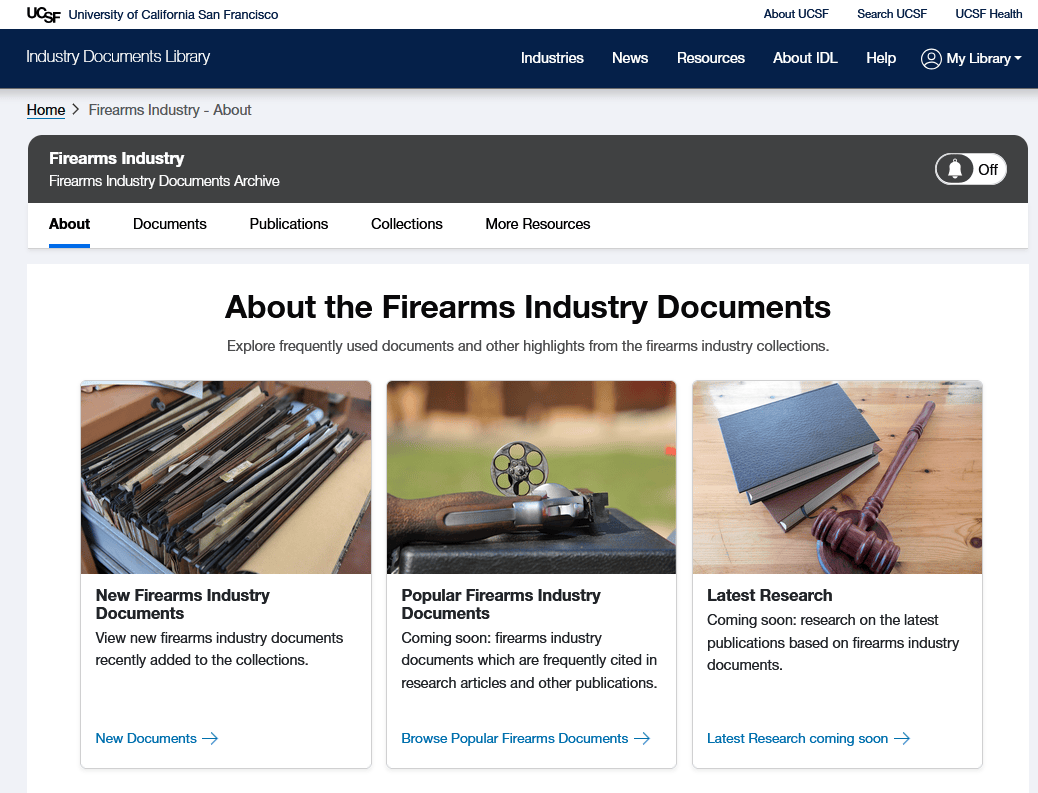
Hopefully, this will just be the first collection in the new Firearm Industry Documents Archive (FAIDA) that is now part of IDL. (Access the collection here.) Like all the other collections in IDL, the firearms documents can be searched separately or together with any or all of the other collections.
Here are details about the new firearms documents, from the UCSF press release on the collection:
Internal documents uncovered in Minnesota Attorney General’s lawsuit reveal how a retailer ignored warning signs.
UC San Francisco’s Industry Documents Library, in partnership with the Minnesota Attorney General’s Office, has made public nearly 700 internal documents from a Midwest retailer as part of the state’s lawsuit alleging the company ignored an internal warning before selling firearms to a straw buyer.
The Aug. 19 release marks the launch of the library’s new firearm industry collection and is the first state-led agreement to include the public release of internal firearms industry documents, making these 694 records publicly accessible for the first time.
The documents were obtained during Minnesota Attorney General Keith Ellison’s 2022 lawsuit, which alleged that Fleet Farm, a 50-store chain that sells firearms, hunting equipment, and other goods in five Midwest states, negligently sold firearms to straw buyers –– people who purchase firearms on behalf of another person –– and contributed to gun trafficking in Minnesota.
Fleet Farm sold at least 37 firearms to two straw purchasers over 16 months, often selling multiple, nearly identical guns in a single transaction or within a short period. One of those guns was later fired in an October 2021 shootout at the Truck Park bar in St. Paul that killed one person and injured 14 bystanders.
Under the February 2026 settlement, the company agreed to significant policy changes to help prevent straw purchases, pay a $1 million penalty, and publicly release the records.
“To those who were skeptical of this lawsuit when I filed it, and skeptical that we could use civil law to hold corporations accountable for their roles in public-safety crises, I trust these documents will put that skepticism to rest,” Ellison said. “My team and I are creating a whole new body of work in successfully using civil law to improve public safety and protect the well-being of Minnesotans everywhere, and we’re going to keep building on it.”
Inside the document library
With the addition of the Fleet Farm records, the [UCSF] library is launching the Firearms Industry Documents Archive as a new resource for researchers, policymakers, journalists, and the public to better understand corporate practices and inform future research, legal action, and public policy.
Support for UCSF’s Firearms Industry Documents Archive comes from the Firearms Accountability Initiative, a collaborative, nonpartisan effort to hold the firearms industry accountable for its role in American gun violence.
“As with the tobacco industry collections, the Firearms Industry Documents Archive will shine a light on corporate practices that cause harm and help to inform solutions to protect public health and safety,” said Kate Tasker, director of the UCSF Industry Documents Library.
More than 1,200 publications have been written based on industry documents, which have paved the way for major tobacco control legislation, including a U.S. law that gives the Food and Drug Administration (FDA) the power to regulate tobacco and a global health treaty under the World Health Organization that prevents the industry from influencing tobacco control laws in many countries around the world.
“They say sunlight is the best disinfectant, and I hope we are able to shine some sunlight on the firearm industry with this release of documents,” Ellison added. “I’m extremely grateful to the University of California, San Francisco’s Industry Documents Library for their partnership, and I hope lawmakers, journalists, and researchers will use these documents to improve the public health and safety of the American people.”
Ignored internal warning
The documents show that Fleet Farm ignored an internal warning about suspicious firearm purchases by Jerome Horton, one of the two straw buyers identified in the lawsuit. Yet just months later, the company used those very same sales to train employees how to identify suspicious purchasing activity, calling them “pretty obvious” examples of transactions that should have raised red flags.
After Horton bought three pistols on July 31, 2021, Fleet Farm employee Cory Klebs alerted one of the company’s firearms compliance employees that Horton had purchased six pistols in just over a week and documented this with two Bureau of Alcohol, Tobacco, Firearms and Explosives (ATF) Multiple Sale forms, which are required when customers buy multiple firearms over a short period. Klebs asked whether Fleet Farm should stop selling guns to Horton, but no one responded.
Fleet Farm completed 11 more sales to Horton before the ATF identified him as a straw buyer in October 2021. Later that year, the company used the same ATF forms Klebs had submitted in employee training, telling staff their “radar should be up” when they encounter similar purchases and that they should seek approval before completing those sales.
The impact of Fleet Farm’s sales
Several of the firearms that Fleet Farm sold to Horton and another straw buyer, Sarah Elwood, were later recovered by law enforcement after being used in crimes or found in the hands of people prohibited from possessing firearms. Among them was a Mossberg MC2C 9mm pistol sold to Horton on July 31, 2021, despite the internal warning. The gun was later fired during the Oct. 10, 2021, mass shooting at the Truck Park bar in St. Paul that killed 27-year-old Marquisha Wiley and injured 14 others.
The Truck Park shooting was not an isolated case. Other firearms sold to Horton were later recovered after being fired in Minneapolis, found by a 6-year-old child, and discovered in the possession of prohibited individuals. A handgun sold to Elwood was also recovered after it was allegedly used to threaten someone in public.
But most of the 13 firearms Fleet Farm sold to Elwood have not been recovered.
This could be just the beginning
Before I retired in 2020, I helped IDL acquire a hard disk with approximately 120,000 Remington Arms documents (952,971 pages) which were produced during the class action lawsuit Pollard v Remington Arms Co filed in 2013. The suit alleged that certain Remington rifles had serious trigger defects which allowed the rifle to fire unexpectedly, and that Remington knew about the defects but did not take adequate action to address them. After the 2014 settlement the documents were sealed; the non-profit organization Public Justice worked with plaintiffs’ lawyers in 2015 to release the documents for public access. Overall subjects include consumer complaints, safety testing and reports, research and development of the Remington Model 700, and fraudulent concealment of trigger defects.
Despite several attempts, we could not local funds to process these documents and make them public as part of IDL. Hopefully now that the Fleet Farm documents have broken the ice, a funder will come forward so these documents can be added to the collection.
Making industry documents public and searchable has empowered academics, journalists, advocates, government agencies and lawyers to learn more about how these industries operate and work to protect public health, as documented in over 1200 publications based on the documents. As Minnesota Attorney General Hubert Humphrey III said about the tobacco industry documents back in the 1990s, “The most important thing to come out of the litigation is the truth.”


Great news! Wonderful for you to get to ponder all that you set in motion re/documents. Hope all goes well by you and family. I’m grateful for what good fortune I have, but angry and horrified at the state of world. All my best, Naphtali
Sent from Yahoo Mail for iPhone
LikeLike