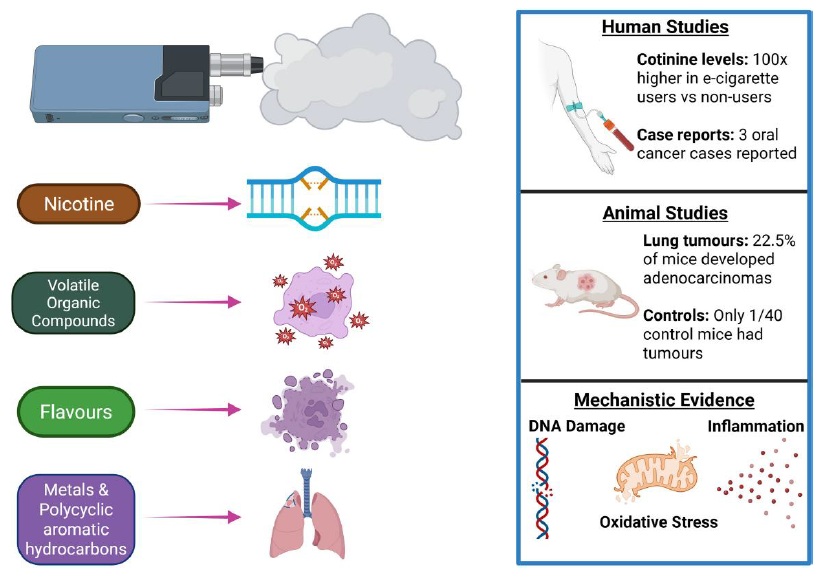
Bernard Stewart and colleagues from Australia just published “The carcinogenicity of e-cigarettes: a qualitative risk assessment” in Carcinogenesis. This review (summary) of the literature cites 116 papers, 15 of which were published in 2025. The fact that so many of the citations are recent is important because the evidence on the health risks of e-cigarettes is rapidly accumulating.
Unlike most discussions of e-cigarettes and cancer, the authors specifically avoided comparisons with cigarettes or even dual users (people who use both ecigs and cigs) and focused on “the carcinogenic impact of e-cigarettes in their own right.” They summarize the ways in which e-cigarette exposure affects carcinogenic mechanisms, including tissue injury as well as laboratory studies of e-cigarette aerosols and their chemical components.
Table 2 of their paper (reproduced below) summarizes the strength of evidence for carcinogenicity using the different factors that the authors consider:
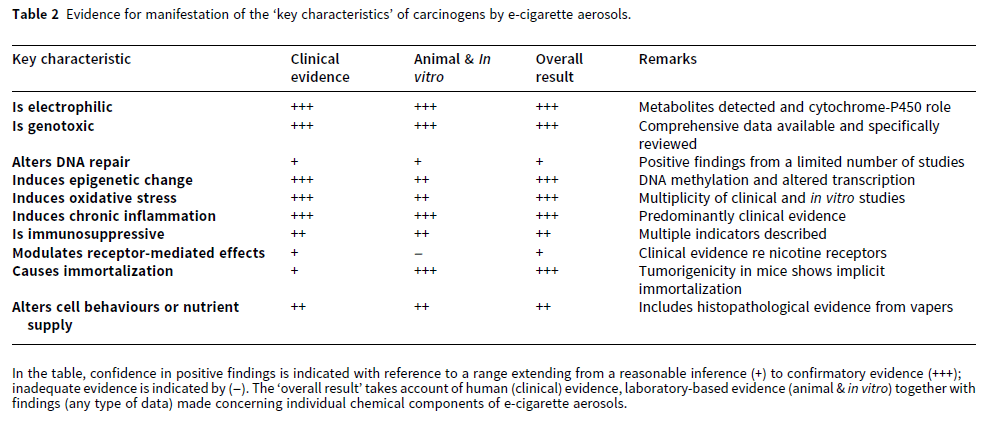
This wide range of effects and the consistency of a range of types of evidence is important when drawing the overall conclusion of carcinogenicity because direct epidemiological evidence in just beginning to emerge. (Unlike cardiovascular, lung, oral and other diseases, where there is already direct human evidence linking e-cigarette use to disease, the long latency period for cancer.) This consistent interlocking evidence stands in stark contrast to the predictable generic criticisms of this paper from England’s Science Media Center. As is typical in criticism from e-cigarette advocates, they ignore the consistent picture (summarized in Table 2 and the abstract) that the evidence from different domains paints.
The authors recognize that their purposefully narrow focus on direct carcinogenicity or e-cigarettes by themselves. They conclude their paper noting, “Qualitative assessment of e-cigarette carcinogenicity is indicative of only one aspect of the potential burden of cancer reasonably anticipated from vaping. This also includes cancer attributable to vapers who transition to smoking and the impact of dual use. Moreover, cancer aside, a range of disease are attributable to vaping which can no longer be caricatured as safer than smoking.”
Here is the abstract:
This review involves a qualitative carcinogenic risk assessment of nicotine-based e-cigarettes. Though direct epidemiological evidence of cancer causation takes time to accumulate, carcinogenicity of e-cigarettes is evident from different types of investigation including, with respect to studies in humans, some case reports but mainly involving monitoring of biomarkers of exposure and biomarkers of harm implicating tumorigenesis. Complementary laboratory investigations of e-cigarette aerosols and constituent chemicals include rodent bioassays and a range of approaches to elucidate mechanism(s). In respect of e-cigarettes, each of these types of investigation have been subject to successive reviews, sometimes more than once per year. Consequently, this over-arching review is restricted to publications since 2017 to avoid possible selection bias. Physiological evidence of exposure using biomarkers reveals DNA damage correlated with vape-derived metabolites attributable to carcinogens including nicotine-derived nitrosamines, volatile organic compounds, flavour-derived agents, and certain metals. Biomarkers also indicate vaping-attributable oxidative stress, epigenetic change and inflammation in oral and respiratory tissue often specified in comparison with smoking. Rodent bioassays include inhalation exposure of mice to e-cigarette aerosol described as causing lung adenocarcinomas. Mechanistic data are presented using the key characteristics of carcinogens and taken together implicate a complex mixture mediating carcinogenicity via genotoxic and other processes. From 2017 to 2025, the conclusions in e-cigarette reviews addressing different avenues of investigation moved from describing a need for more evidence to notifying concern about e-cigarette carcinogenicity. Nicotine-based e-cigarettes are likely to be carcinogenic to humans who use them causing an indeterminate burden of oral cancer and lung cancer.
This is an expanded and even more definitive assessment of e-cigarette carcinogenicity than was made the report last year to the Clinical Oncology Society of Australia (COSA). In addition to being externally peer reviewed, it reflects the additional literature published in the 14 months following when the literature review for the COSA report was completed.
The full citation is: Stewart BW, Marshall H, Bonevski B, Griffin HJ, Hopkins AM, Itchins M, Mazza CJ, Modi ND, Ryan M, Varlow M, Sitas F. The carcinogenicity of e-cigarettes: a qualitative risk assessment. Carcinogenesis. 2026;47: 1-14 doi: 10.1093/carcin/bgag015. PMID: 41910510. It is available here.
 Stanton Glantz blog