With some notable exceptions. e-cigarettes have been embraced by British tobacco control advocates and public health authorities more enthusiastically than anywhere else in the world, including authorities at Action on Smoking and Health (ASH) and University College London (UCL).
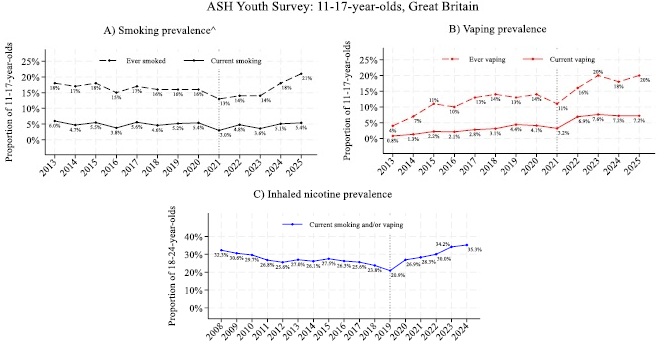
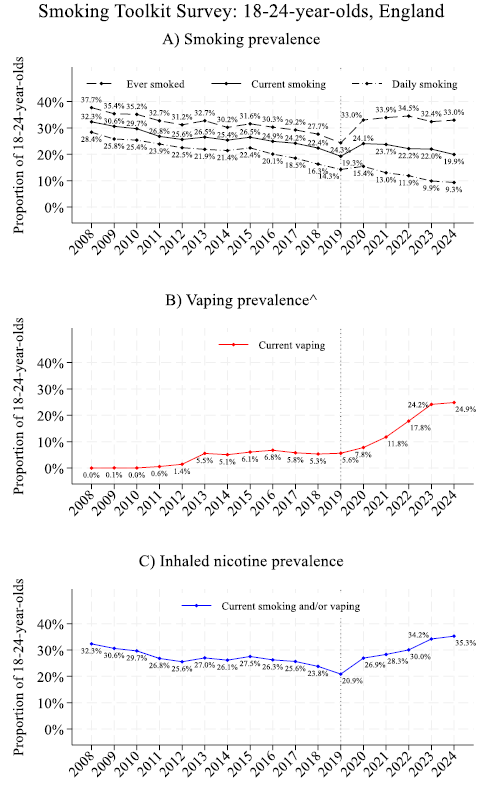
Now, Emily Banks, Andrew Bush, Charlotta Pisinger, and Sam Egger have published Signs of increased smoking and vaping among young people in UK in BMJ that shows that both ASH’s Smokefree Great Britain Youth Survey of 11-17 year olds (above; from Egger) and UCL’s Smoking Toolkit Study (STS) of 18-24 year olds (below) notes increases in both smoking and vaping in recent years. (And so is use of either product.)
Banks and colleagues describe this situation:
Although many factors can influence population smoking prevalence, the elephant in the room is the possibility that recent shifts in youth smoking are at least partly causally linked to rises in vaping. This idea—commonly known as the “gateway hypothesis”—is supported by consistent evidence from prospective cohort studies from different countries, showing that young people who vape are around three times as likely to start smoking as those who don’t, even after accounting for risk factors (common liabilities) for both vaping and smoking.
In New Zealand and Australia, falls in adolescent smoking prevalence significantly slowed after vaping emerged, while in Ireland, falls in smoking prevalence among 15-24 year olds also slowed amid rapid rises in vaping. In Britain, falling trends in both adolescent and young adult ever and current smoking reversed direction, with prevalences rising when vaping increased rapidly. [citations deleted]
We reported similar findings among American youth. While it is true that some kids who start nicotine with e-cigs have risk factor patterns similar to kids who start with cigarettes, several studies have shown that a substantial fraction of kids who start with e-cigs have risk factor patterns that make it unlikely that they would ever pick up a cigarette.
The fact that increases in youth e-cigarette use have been larger than any drops in cigarette smoking is also evidence against the so-called common liability theory. If e-cigarettes were just attracting kids who otherwise would have been smokers, the opposite would have been true.
In any event, Banks and colleagues show that in England both e-cigarette use and smoking cigarettes are increasing. The result: as elsewhere, historical declines in total (cigarette + e-cigarette) have reversed and total nicotine use is now increasing.
Banks and colleagues gently note that the British e-cigarette enthusiasts have done their best to sidestep this reality: “However, interpretations of these coinciding shifts have varied, with limited weight given to the possibility that vaping is contributing to apparent rises in smoking [citations deleted].”
As ASH and UCL’s data convincingly show, in England, as elsewhere, the cigarette gateway has two doors:
- Some youth initiate nicotine addiction starting with cigarettes
- More start with e-cigarettes, some of whom go on to cigarettes, often as dual users with e-cigarettes
As Banks and colleagues note, “Young people are a prime target of the tobacco and nicotine industries as replacement customers. They are not solely ‘collateral damage’ of products aimed at adults. Globally, available data indicate children aged 13-15 years are on average nine times as likely to vape as adults [citations deleted].” E-cigarette advocates in England (and everywhere) need to accept this reality, as well as the reality that e-cigarettes as consumer products promote more dual use than quitting among smokers and should not be promoted for cessation anyway.
The full citation is Banks E, Bush A, Pisinger C, Egger S. Signs of increased smoking and vaping among young people in UK BMJ 2026; 392 :r2625 doi:10.1136/bmj.r2625. It is available here.
 Stanton Glantz blog