
Mark Salazar, and his colleagues at UC Davis new paper “Elevated Toxic Element Emissions from Popular Disposable E‑Cigarettes: Sources, Life Cycle, and Health Risks” provides a comprehensive analysis that shows that how popular disposable e-cigarettes (Esco Bar, Flum Pebble, and ELF Bar) expose users to levels of toxic metals that are orders of magnitude higher in concentration than traditional cigarettes and other e-cigarettes.
They explain the importance of exposure to metals: “respiratory exposure to these elements at sufficient doses can increase the risk of potential serious health effects such as neurotoxicity, cardiovascular disease, renal disease, respiratory disease and lung cancer with children being disproportionately susceptible to the neurotoxic effects of [lead] Redox-active elements (e.g., [iron]) present in aerosols may facilitate production of excess reactive oxygen species (ROS), which can damage cells and induce inflammation contributing to the development of respiratory diseases such as cancer, asthma, and lung fibrosis. [citations dropped]”
They provide detailed analysis of the sources of these metals (the heating element, other components of the e-cigarette, and the e-liquid), how the exposures change over time as the e-cigarette is used and the differences between brands. Specifically, “Metal and metalloid concentrations were quantified in virgin e-liquids (i.e., prior to device use), aged e-liquids (i.e., after device use), and aerosols over the device life cycle.”
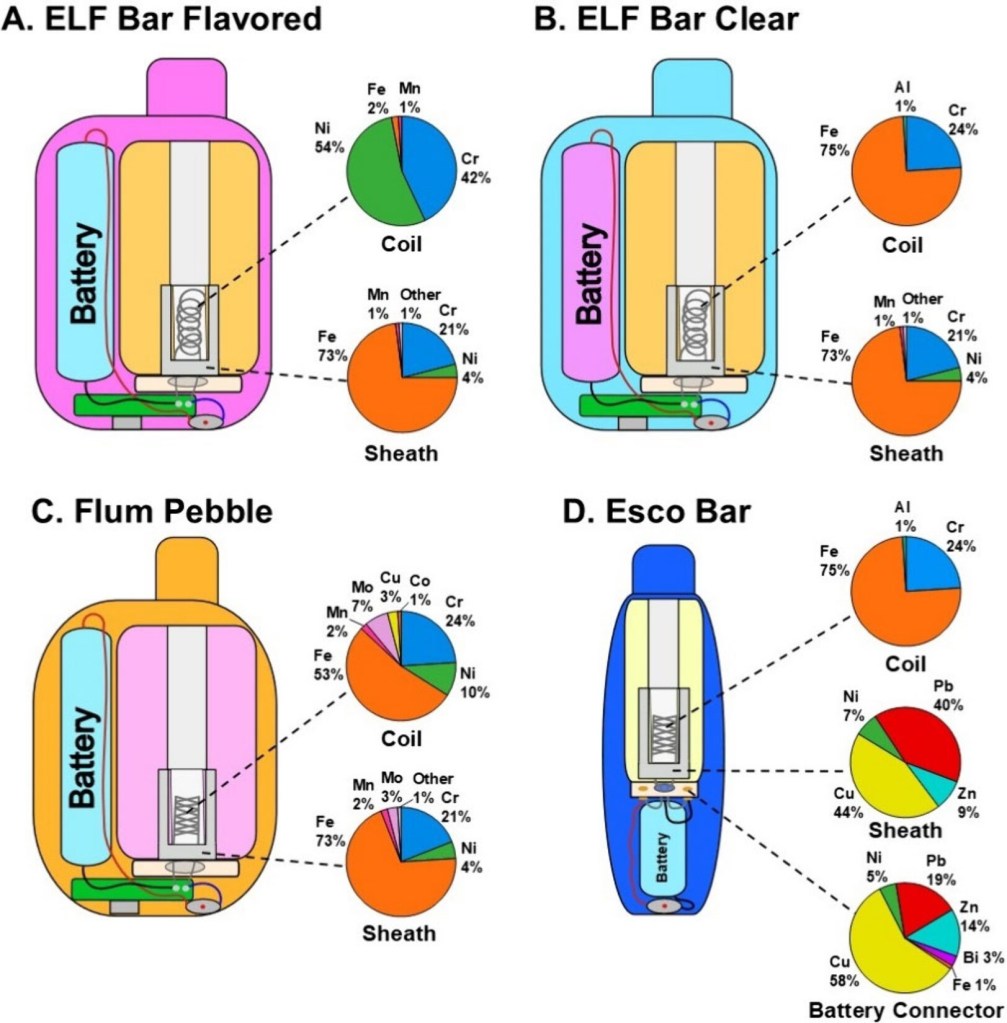
There a wide differences between different brands in terms of all the elements they examined.
The figure to the left shows differences in the metals in the heating coils, sheaths, and battery connectors.
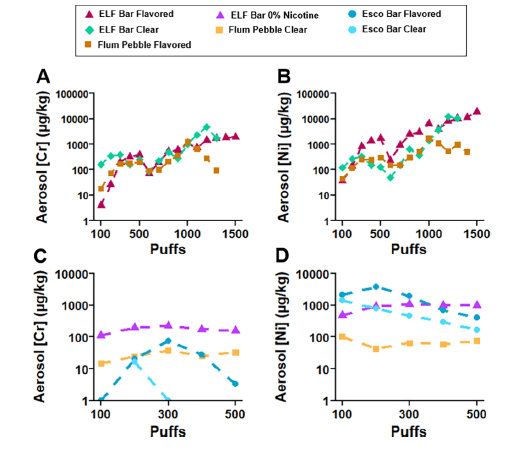
The figure to the right shows differences in chomium (Cr) and nickel in the aerosol that users inhale across brands and how delivery changes as the e-liquid is consumed, with exposures increasing as the e-liquid is consumed in some brands.
They also found that cancer and non cancer risks associated with several of the products exceeded conventional danger levels.
The much higher concentrations of toxic metals in these e-cigarettes than cigarettes adds to the case that making risk statements based on a limited number of cigarette combustion products is too limited an approach. These higher concentrations also help explain why dual use (using e-cigarettes and cigarettes) is more dangerous than using either product alone (podcast).
Here is the abstract:
The rapidly evolving market of disposable ecigarettes poses unknown health risks to adolescents and young adults. We report excessive emissions of toxic metallic elements in aerosols from flavored and “clear” versions of three popular products (Esco Bar, Flum Pebble, and ELF Bar), orders of magnitude higher in concentration than traditional cigarettes and other e-cigarettes. Heating coil elements (chromium (Cr), nickel (Ni)) likely leached into e-liquids and aerosols from coil degradation during use, increasing up to 1000-fold in concentration over the device life. In Esco Bar devices, high concentrations of lead (Pb, ≤175 ppm), Ni (≤38 ppm), copper (Cu, ≤546 ppm), and zinc (Zn, ≤462 ppm) were observed in both e-liquids and aerosols. We identified the illicit use of leaded bronze in nonheating device components in contact with e-liquid as the source of Pb. Elevated antimony (Sb) in Flum Pebble and Esco Bar samples had unknown origins. Analyses showed Cr was present as nontoxic Cr(III), while Sb was a mixture of nontoxic Sb(V) and carcinogenic Sb(III). Risk assessments revealed cancer risks from Ni and Sb(III) and noncancer toxicity risks from Pb and Ni exceeded safety thresholds. These findings highlight critical gaps in e-cigarette regulation, characterization, and enforcement, with implications for public health.
The full citation is: Salazar MR, Saini L, Nguyen TB, Pinkerton KE, Madl AK, Cole AM, Poulin BA. Elevated Toxic Element Emissions from Popular Disposable E-Cigarettes: Sources, Life Cycle, and Health Risks. ACS Central Science. 2025:doi: 10.1021/acscentsci.5c00641. It is available here.
 Stanton Glantz blog