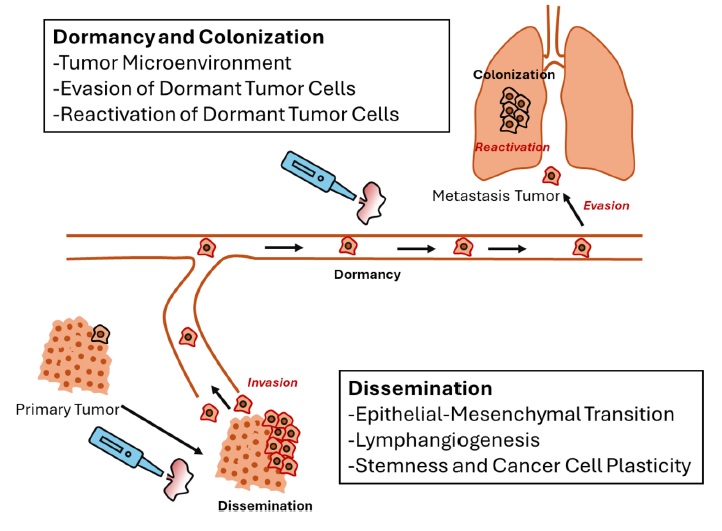
E-cig advocates and regulators including the FDA continue to assume that e-cigarettes pose much lower cancer risks than cigarettes because e-cigarettes deliver much lower levels of cancer-causing chemicals (carcinogens) produced by burning tobacco. This oversimplified logic ignores that we now understand a lot more about the cancer process and the fact that there are complex changes in cells and how the interact and communicate that affect not only the initiation of cancer (i.e.., carcinogenesis) but also its development, how cancer cells evade or fight off the body’s immune system’s efforts to fight cancer, and how cancer cells spread through the body (metastasis).
Yibo Xi and colleagues at Yale recently published and excellent literature review, Vaping and tumor metastasis: current insights and progress, showing several specific biological pathways through which e-cigarette exposure changes the tumor microenvironment (TME) in a way that promotes metastasis of tumors once they are established. These include:
- E-cig exposure loosens connections between cells (so-called s epithelial-mesenchymal transition, EMT) which increases cell migratory and invasive capabilities
- E-cigarette exposure promotes growth of the lymphatic system (lymphangiogenesis) that provides a “highway” for cancer cells to move from one part of the body to another, aiding tumor cell spread
- E-cigarette exposure can create pre-metastatic niches, which are local environmental changes that support dormant tumor cells, enhancing their reactivation and colonization
- E-cigarette exposure affects macrophages (part of the immune system) which impacts the body’s ability to fight cancer cells
- E-cigarette exposure can induce specific DNA changes (epigenetic changes), in genes involved in metastasis:
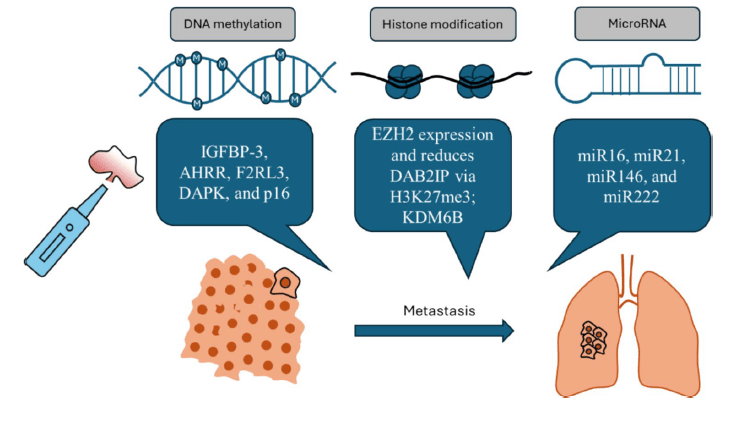
They also quote our paper, noting that consistent with the broader evidence, “exposure to the main components of electronic cigarettes, PG/VG and nicotine, significantly promotes tumor invasion, metastasis, and immunosuppression, while also increasing immune check
point markers like CTLA4 and PD-1,” suggesting that,” while not direct carcinogens,
these components of e-cigarettes pose significant risks by accelerating tumor progression and impairing antitumor immunity.”
The bottom line: The discussion of e-cigarettes and cancer needs to move beyond just the association between e-cigarette use and cancer induction (carcinogenesis), but to the speed of cancer development and spread in a way that reflects modern cancer biology.
Here is the abstract:
Tumor metastasis is the primary cause of cancer-related mortality and remains a major hurdle in cancer treatment. Traditional cigarette smoking has been extensively studied for its role in promoting metastasis. However, the impact of e-cigarette (e-cig) on cancer metastasis is not well understood despite their increasing popularity as a supposedly safer alternative. This mini review synthesizes current literature on the effects of e-cig on cancer metastasis, focusing on the processes of dissemination, dormancy, and colonization. It also incorporates recent findings from our laboratory regarding the role of e-cig in tumor progression. E-cig exposure enhances metastatic potential through various mechanisms: it induces epithelial-mesenchymal transition (EMT), increasing cell migratory and invasive capabilities; promotes lymphangiogenesis, aiding tumor cell spread; and alters the pre-metastatic niche to support dormant tumor cells, enhancing their reactivation and colonization. Furthermore, e-cig induce significant epigenetic changes, such as DNA methylation and histone modifications, which regulate genes involved in metastasis. Our data suggest that e-cig upregulate histone demethylases like KDM6B in macrophages, impacting the TME and promoting metastasis. These findings underscore the need for further research to understand the long-term health implications of e-cig use and inform public health policies to reduce e-cig use.
The full citation is Xi Y, Yang L, Burtness B, Wang H. Vaping and tumor metastasis: current insights and progress. Cancer Metastasis Rev. 2024 Nov 25;44(1):4. doi: 10.1007/s10555-024-10221-7. PMID: 39581913. It is available here.

