
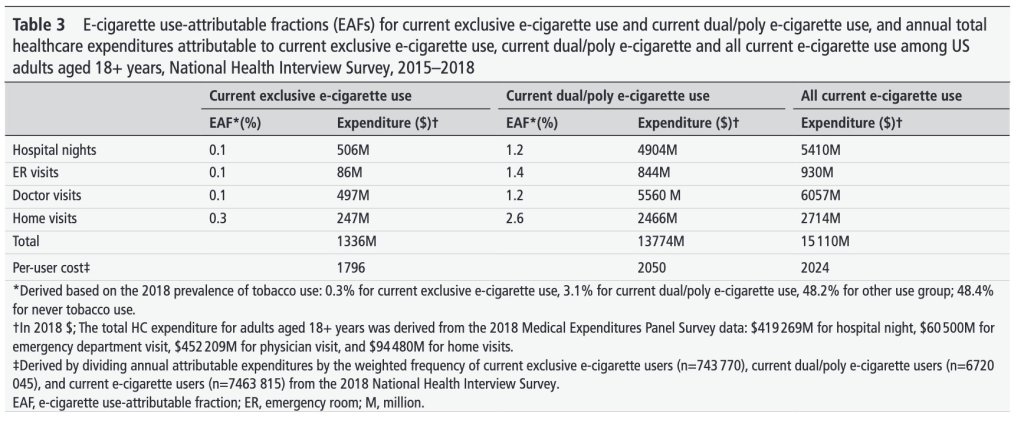
Until now we have not had direct estimates of the costs of treating the excess disease that e-cigarettes cause. Now, Yingning Wang and her UCSF colleagues have published Healthcare utilisation and expenditures attributable to current e-cigarette use among US adults that applies the same well-established methods they have used to estimate the medical costs of smoking cigarettes and other tobacco products to adult (18+) use of e-cigarettes. They find that adult e-cigarette users incur an average of $2024 (in 2018) more in medical costs every year than comparable people who do not use e-cigarettes.
The obtained this estimate in three steps:
- Estimate the association between e-cigarette use and health status (excellent, very good, good, fair, or poor’), accounting for differences in sociodemographic variables
- Estimate the level of medical service utilization (hospital nights, emergency room visits, doctor visits and home health visits) used by people with different health status.
- Combine these two results to obtain the medical costs incurred by the average adult e-cigarette user
In making these estimates, they accounted for current or former smoking or other tobacco use. They also accounted for the fact that e-cigarette users might have different patterns of medical service utilization because of different attitudes toward risk.
This estimate is likely an underestimate for several reasons. First, e-cigarette users tend to be younger, so have not lived long enough to manifest many disease that e-cigarettes will eventually cause. The fact that the adverse effects of e-cigarettes — like cigarettes and other tobacco products — almost certainly increase the longer one uses them also means that the analysis is not capturing the full eventual risks of e-cigarettes. (Their analysis includes age, but cannot account for things that haven’t happened yet.) In addition, as Wang and colleagues note, they were not able to account for many other medical care
services such as nursing home care, medications or dental care because the necessary data are not available.
For comparison they quote an estimate using similar methods that the average cigarette smoking incurred about $5602 in excess medical costs in 2018. In comparing this estimate with the estimate for e-cigarette-induced medical costs, it is important to keep in mind the fact that e-cigarettes have not been in use long enough for the full medical costs to become manifest. Nevertheless, the medical costs associated with e-cigarette use are still substantial, about 36% of that associated with cigarettes.
This is well above the 5% risk still being promoted by England and the industry as well as the 15% risk the FDA uses.
And the total cost was $15.1 billion in 2018. Moreover, as Wang and colleagues point out, “If current youth e-cigarette users continue to use e-cigarettes when they become adults the negative impacts of e-cigarette use on healthcare utilisation and spending are likely to increase over time.”
Here is the abstract:
Aims This study estimated annual healthcare expenditures attributable to current e-cigarette use among US adults, including current exclusive and dual/poly e-cigarette use.
Methods Analysing the 2015–2018 National Health Interview Survey data, we estimated the impacts of e-cigarette use on healthcare utilisation among adults aged 18+ years. Healthcare utilisation outcomes were hospital nights, emergency room (ER) visits, doctor visits and home visits. Current e-cigarette use was categorised as exclusive and dual/poly e-cigarette use. The econometric model included two equations: health status as a function of e-cigarette use and other independent variables, and healthcare utilisation as a function of health status, e-cigarette use, and other independent variables. Using an ‘excess utilisation’ approach, we multiplied the e-cigarette-attributable fraction derived from the model by annual health expenditures to calculate healthcare expenditures attributable to current exclusive and dual/poly e-cigarette use, the sum of which were expenditures attributable to all current e-cigarette use.
Results Current exclusive and dual/poly e-cigarette use, with 0.2% and 3.5% prevalence in 2015–2018, were associated with higher odds of reporting poor health status than never tobacco users. Poor health status was associated with higher odds of using the four healthcare services and a greater number of ER and doctor visits. Annual healthcare expenditures attributable to all current e-cigarette use was $15.1 billion ($2024 per user) in 2018, including $1.3 billion attributable to exclusive e-cigarette use ($1796 per user) and $13.8 billion attributable to dual/poly e-cigarette use ($2050 per user).
Conclusion Adult current e-cigarette use was associated with substantial excess healthcare utilisation and expenditures.
The full citation is: Wang Y, Sung HY, Lightwood J, Yao T, Max WB. Healthcare utilisation and expenditures attributable to current e-cigarette use among US adults. Tob Control. 2023 Nov;32(6):723-728. doi: 10.1136/tobaccocontrol-2021-057058. Epub 2022 May 23. PMID: 35606163. It is available here.
 Stanton Glantz blog