
Muhammad Talal Ashraf and his colleagues recently published “Association between e‑cigarette use and myocardial infarction: a systematic review and meta‑analysis” that pools the results of epidemiological studies and found that overall e-cigarette users are more likely to have had heart attacks than nonusers (odds ratio [OR] 1.44; 95% CI 1.22-1.74).
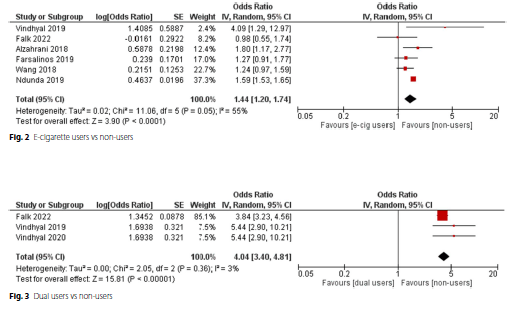
They also found that dual users (people who use both e-cigarettes and cigarettes at the same time) have an even higher risk of having had a heart attack (OR = 4.04; 95% CI 3.40-4.81). This latter finding is particularly important because dual use is common among adult e-cigarette users.
The issue of dual use is particularly important when assessing the value of giving smokers e-cigarettes as a smoking cessation aid. While a recent well-done randomized controlled trial found that more people who were given e-cigarettes stopped smoking cigarettes than in the control group, the even more became dual users. For every person who stopped smoking cigarettes (including switchers who continued using e-cigarettes and quitters who did not smoke cigarettes or use e-cigarettes) in the group that were provided e-cigarettes, 2.7 smokers became dual users.
The fact that dual use is associated with such a high risk of heart attack likely overwhelms any benefits of switching completely.
People doing studies (both RCTs and observational studies) need to start reporting not only what fraction of smokers who use e-cigarettes stop smoking cigarettes, but also what fraction become dual users.
Regulatory bodies including the FDA also need to take dual use more seriously when deciding whether e-cigarettes are appropriate for the protection of public health.
A LIMITATION
A limitation of this meta-analysis is that all the studies are cross-sectional (a snapshot in time), leaving open the possibility that the heart attack occurred before the person was using e-cigarettes.
The way to avoid this problem is to do a longitudinal study in which people are followed forward in time after they start using e-cigarettes. Unfortunately, longitudinal studies take a long time (because you have to wait for people to have the heart attack). In addition, to be sensitive enough to detect an effect (what statisticians call power) on rare events like heart attacks , you need a large sample size. Following people forward in time for years is also hard. As a result, longitudinal studies are much more expensive than cross-sectional studies. As a practical matter, you also need cross-sectional studies justify the expense of longitudinal studies. In the meantime, cross-sectional studies provide important information, especially since the results are what one would expect based on the adverse biological effects of e-cigarettes on the cardiovascular system.
Here is the abstract:
Background: The popularity of e-cigarettes has risen dramatically over the last few years, particularly among the younger population. Although the use of combustible cigarettes has established evidence to be associated with the development of several adverse cardiopulmonary diseases, the investigations regarding the prospective long-term effects of e-cigarette use on the cardiovascular system have just begun. We set to investigate if there is an association between the history of MI and e-cigarette use among smokers and non-smokers?
Methods: The current review aims to assess the association of myocardial infarction with e-cigarette consumption. PubMed, Google Scholar, and Cochrane Central Register of Controlled Trials (CENTRAL) were queried up to October 2022 to identify articles assessing the incidence of myocardial infarction among e-cigarette users. Data were meta-analyzed using a random-effects model to derive odds ratios (OR) and 95% confidence intervals.
Results: Nine studies involving 984,764 patients were included. The mean age of e-cigarette smokers was less than the controls, and female participants dominated the sample size. E-cigarette users were associated with increased odds of MI than non-users [OR = 1.44; 95% CI (1.22, 1.74); P < 0.0001]. Dual users were also associated with increased odds of MI with large effect when compared to non-users [OR = 4.04; 95% CI (3.40, 4.81); P < 0.00001].
Conclusions: Dual use is associated with an increased risk of MI than e-cigarette use only. Similarly, dual and solely e-cigarette consumption patterns of nicotine delivery are at a higher risk of MI than non-smokers.
The full citation is: Ashraf MT, Shaikh A, Khan MKS, Uddin N, Kashif MAB, Rizvi SHA, Khalid H, Sam SJ, Sohail A. Association between e-cigarette use and myocardial infarction: a systematic review and meta-analysis. Egypt Heart J. 2023 Nov 30;75(1):97. doi: 10.1186/s43044-023-00426-6. PMID: 38032522; PMCID: PMC10689622. It is available here.
 Stanton Glantz blog