
Two papers are being presented today (November 13, 2023) at the American Heart Association Annual Scientific Sessions that show marijuana use is associated with increased cardiovascular disease.
The first, Daily Marijuana Use is Associated With Incident Heart Failure: “All of Us” Research Program reports a 34% increased risk of incident heart failure in daily recreational cannabis users in a prospective study of 159,666 individuals followed for about 4 years (median followup 45 months) in the National Institutes of Health “All of Us” research program. The investigators excluded prescribed marijuana use and , adjusted for demographic and socioeconomic factors, diabetes mellitus, hypertension, hyperlipidemia, BMI, alcohol use and tobacco smoking. Compared to never users, daily marijuana users had an increased risk of incident heart failure (adjusted hazard ratio (aHR): 1.34, 95% CI 1.04-1.72).
They also found that this risk was independent of tobacco smoking. This is an important result because many marijuana users also smoke tobacco, so one always has to be concerned that the risks attributed to marijuana were due to confounding with smoking. The relationship was attenuated after addition of coronary artery disease diagnosis as a time varying covariate in our main model (aHR – 1.27, 95% CI 0.99-1.62), but this could also be over-correcting to the extent that marijuana increases the risk of coronary artery disease.
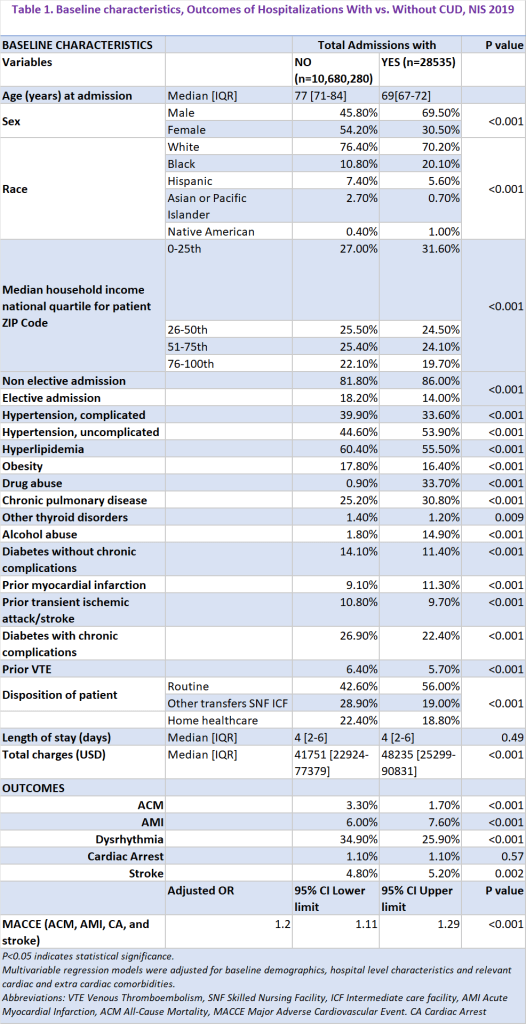
The second, Increased Risk of Major Adverse Cardiac and Cerebrovascular Events in Elderly Non-Smokers With Cannabis Use Disorder: A Population-Based Analysis, found increases in major adverse cardiovascular events in the 2019 National Inpatient Sample, among nonsmokers over 65 years old with increased cardiovascular risk (due to type 2 diabetes, high blood pressure, or high cholesterol) who use marijuana. Because they limited their sample to nonsmokers (“people without tobacco use disorder”), this result could not be due to confounding with smoking. Specifically, the authors found a 20% increased risk of heart attack, stroke, cardiac arrest, or arrhythmia (irregular heartbeat).
These results are particularly important for middle-aged and older people, many of whom have cardiovascular risks, and who may be using cannabis frequently for pleasure, or to sleep or to handle stress.
Here are the abstracts:
Daily Marijuana Use is Associated With Incident Heart Failure: “All of Us” Research Program
Yakubu Bene-Alhasan, et al.
Background: With the increasing state-level legalization of marijuana across the United States, its use has increased exponentially, especially among the youth. However, a lot remains unknown concerning its cardiovascular health implications. We sought to assess the association between the frequency of marijuana use and new-onset heart failure (HF).
Methods: Using the NIH-sponsored “All of Us” Research Program, we performed a prospective analysis of participants’ survey data and Electronic Health records (EHR). We excluded patients with a baseline EHR diagnosis of HF. Marijuana use was defined as any unprescribed use or if prescribed, use beyond prescribed doses, and was collected using the NM ASSIST instrument. We determined the association between the frequency of marijuana use and incident HF using Cox proportional hazards models adjusted for demographic and socioeconomic factors, diabetes mellitus, hypertension, hyperlipidemia, BMI, alcohol use and smoking status.
Results: From a final population of 156,999, there were 2958 events within a median follow-up time of 45 months. Compared to never users, daily marijuana users had an increased risk of incident HF (aHR – 1.34, 95% CI 1.04-1.72). In subgroup analyses, frequency of marijuana use was not associated with incident HFrEF nor HFpEF. There was no evidence of effect modification by age, sex at birth nor smoking status. The relationship was attenuated after addition of coronary artery disease diagnosis as a time varying covariate in our main model (aHR – 1.27, 95% CI 0.99-1.62).
Implication: Data on the cardiovascular effects of marijuana use is limited. To our knowledge this is the first prospective analysis on the association of marijuana use and HF. Our study suggests daily marijuana use is associated with HF. More research into the cardiovascular effects of marijuana is needed to enable clinicians provide the public with high quality information on the health implications of marijuana and to guide policies.

Increased Risk of Major Adverse Cardiac and Cerebrovascular Events in Elderly Non-Smokers With Cannabis Use Disorder: A Population-Based Analysis
Avilash Mondal et al.
Background: Tobacco smoking confounds CVD risk studies. No large-scale investigation has been performed yet to examine cannabis use disorder (CUD) in elderly non-smokers with established CVD risk and major adverse cardiac and cerebrovascular events (MACCE).
Methods: The National Inpatient Sample (2019) was queried using relevant ICD-10 codes to identify elderly (>65 years) admissions with established CVD risk without known tobacco use disorder and stratified into CUD and non-CUD cohorts. Logistic regression evaluated MACCE odds as primary outcomes and secondary outcomes as predictors of MACCE incidents in CUD users. P< 0.05 was considered significant.
Results: Of 28,535 elderly cannabis users with CVD risk and no tobacco use disorder, 13.9% reported MACCE episodes. CUD patients were more likely to be male, black, and non-electively admitted from urban teaching and Western region hospitals. AIDS, alcohol abuse, depression, uncomplicated hypertension, and drug abuse were greater in the CUD cohort, while the non-CUD group had more complicated hypertension, diabetes with and without chronic comorbidities, hyperlipidemia, obesity, thyroid issues, previous strokes, VTE, cancer. The CUD cohort reported higher MACCE (OR 1.20; 95% CI 1.11-1.29). ACM (3.3% vs. 1.7%), dysrhythmia (34.9% vs. 24.9), acute myocardial infarction (7.6% vs. 6.0%, p 0.001), transfer to other facilities (28.9% vs. 19.0%), and home health care (22.4%) compared to non-CUD cohort (p 0.001). Chronic lung disease, renal disease, hypertension, and hyperlipidemia were predictors of MACCE episodes in CUD users.
Conclusion: Even after controlling for smoking, elderly cannabis users having CVD risk had 20% more MACCE events encountered than non-users. Cannabis use in older non-smokers deserves investigation into CVD.
 Stanton Glantz blog