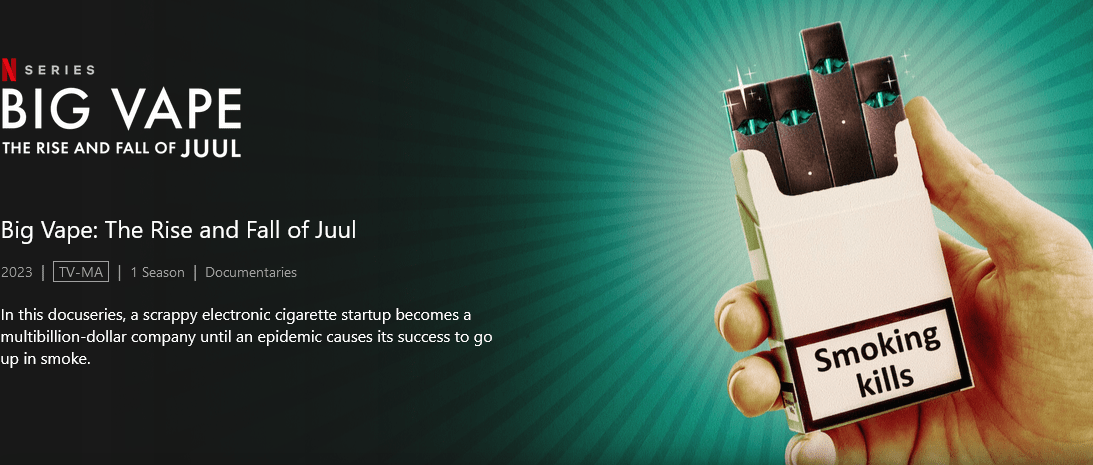
Like Jamie Ducharme’s book Big Vape, the four hour (in four episodes) Netflix documentary Big Vape tracks Juul’s development from an idea by two Stanford grad students to compete with Big Tobacco by creating a less dangerous product to replace cigarettes into part of the tobacco industry. It does a particularity good job of highlighting the company’s decision to abandon its “help adult smokers quit” mission to “making as much money as possible” when Juul released its initial marketing campaign that was so effectively targeted at young people. It also highlights Juul’s shift from competing with the big cigarette companies to being integrated into Big Tobacco by selling one-third of the company to Altria (which owns Philip Morris, maker of Marlboro).
The documentary features two classes of current and former Juul employees: people on the record and people whose identity is protected. Needless to say, the people whose identity is protected have more critical things to say about Juul. (Juul’s two founders, Adam Bowen and James Monsees, did not grant interviews.) The people who spoke on the record were likely thinking about their nondisclosure agreements when they described events inside the company. A friend who served as an expert witness in the litigation against Juul told me, without disclosing any details, that the internal documents produced in the litigation against Juul tell a much darker story than these on-the-record employees presented. (The documents will eventually be made public.)
An important point Duchame made in her book, which is included in the documentary, is Juul’s ability to communicate with and remotely control the e-cigarette. This capability allows Juul to collect data on details of user puffing patterns and would allow Juul to remotely adjust the device to make it more addictive. The documentary features a clip of me describing a meeting we had with Juul leadership 4 or 5 years ago in which they asked what we thought of programming the device not to work in schools. That means they can sense where it is and remotely control it. Very scary. I told them it was like Facebook merging with the Medellín cartel. Juul has now submitted Juul 2 to the FDA for marketing authorization justifying this two-way communication as a way to protect kids. FDA should not let them — or any other company — engage in such dangerous two-way communication and control of devices that deliver the addictive drug nicotine.
Like the book, the documentary is sympathetic to the idea of e-cigarettes as a cessation product that is substantially safer than cigarettes.
The documentary shows lots of adults thanking Juul for helping them quit smoking cigarettes, but ignores the large body of scientific evidence that e-cigarettes, as consumer products, do not help smokers quit. Indeed, over the long run, e-cigs keep people smoking cigarettes. As former CDC Director Tom Friedan says, “the plural of anecdote is not evidence.”
Sympathy for Juul is most evident in the fourth episode, in which David Abrams dismisses evidence of e-cigarette dangers on the grounds that they are “just animal studies” and an unnamed person makes the point that passing cigarette smoke through cotton balls turns them brown whereas passing e-cigarette aerosol through them leaves them white. Abrams’ dismissal of animal studies echoes tobacco company dismissals of the animal studies linking cigarette smoke with cancer in mice in the 1950s. (While the documentary didn’t present it, e-cigarettes also cause lung cancer in mice.) The presentation of the cotton balls is akin to telling someone that it is safer to drink a glass of gasoline than a glass of chocolate milk because the gasoline is clear and the milk is brown.
The documentary also includes then-FDA Center for Tobacco Products Director Mich Zeller praising Juul technology for delivering nicotine like a cigarette without the combustion. This statement reflects the FDA’s general assumption that avoiding combustion gets rid of most of the risk: it doesn’t. Zeller also goes on to say the company undid the benefit by going after kids. The FDA subsequently denied Juul’s request for marketing authorization, but did so on narrow toxicological grounds, not the widespread use by kids. Juul sued and FDA backed down and allowed sales to continue while FDA negotiates with Juul.
Nevertheless, Big Vape is definitely worth watching. Just keep the pro-e-cigarette tilt in mind.
Big Vape joins CNBC’s Juul: Follow the Money and the New York Times’ Move Fast and Vape Things documentaries on Juul’s history as well as Duchame’s book Big Vape and Lauren Etter’s The Devil’s Playbook. While all tell the Juul story, each has a different focus and emphasis and details not available in the others. All are worth watching and reading.
 Stanton Glantz blog
It was outstanding. I sent a note to my team as soon as I was done with it, saying they needed to watch it. I am now reading the book. I think the most important aspect of it was showing the visual sorcery they used to hook kids. I had heard about it, but not seen it. The board’s avarice and impatience to cash in fed the misguided initial advertising. The joinder with PM was the death knell, in a sense that they finally dropped all pretense of being public health oriented. I enjoyed seeing you and Proctor telling it like it is.
LikeLike