
Last week, the Guardian published a detailed article, Lobbyists with links to Big Tobacco fund pro-vaping Facebook campaigns: Secretive lobby groups are spreading pro-e-cigarette messages purporting to be grassroots campaigns, detailing how historical tobacco industry allies and third parties have created a network to make it look like there is grass-roots opposition to regulate e-cigarettes. For example, the article details how “a movement called We Vape UK, which claims to be run by an “independent” organisation “for vapers by vapers”, … was set up by a fellow at the Adam Smith Institute, a free market lobby group that does not disclose its funders and has long-running ties to the tobacco industry.”
According to the article,
Other posts encourage people to fill out a form that sends a letter to their local MP. The prepared letter is signed with the person’s name and urges the MP to “stand up for me and the many thousands of people who vape in your constituency” by opposing policies to regulate vaping.
Two further campaigns – Say No To WHO and Save My Vape – are linked to Global Britain Ltd, an anti-EU pressure group run by Brian Monteith, a PR consultant and former Brexit party politician who is described by Bath University’s TobaccoTactics research unit as a “veteran campaigner against tobacco control”. In the past three months alone, Say No To WHO has paid for 12 ads on Facebook which have been shown to around 2.4 million people in the UK.
The article details many other activities to promote vaping and respond to the fact that some British authorities are starting to react to the rapid growth of youth e-cigarette use. (Unfortunately, they continue to promote the myth that e-cigarettes as consumer products help adults quit smoking.)
This industry effort to use opaquely-funded “third parties” to promote e-cigarettes is no new. In 2016 we published E-cigarette Policymaking by Local and State Governments: 2009-2014 that described how Big Tobacco displaced and took control of the grassroots network that formed among independent e-cigarette vape shops and users before Big Tobacco got into the e-cigarette business in the USA. As in England, pro-business think tanks, libertarian organizations and others with longstanding ties to tobacco suddenly developed an interest in “harm reduction” and started pushing Big Tobacco positions. This article has a useful appendix listing many of these organizations (as of 2014).
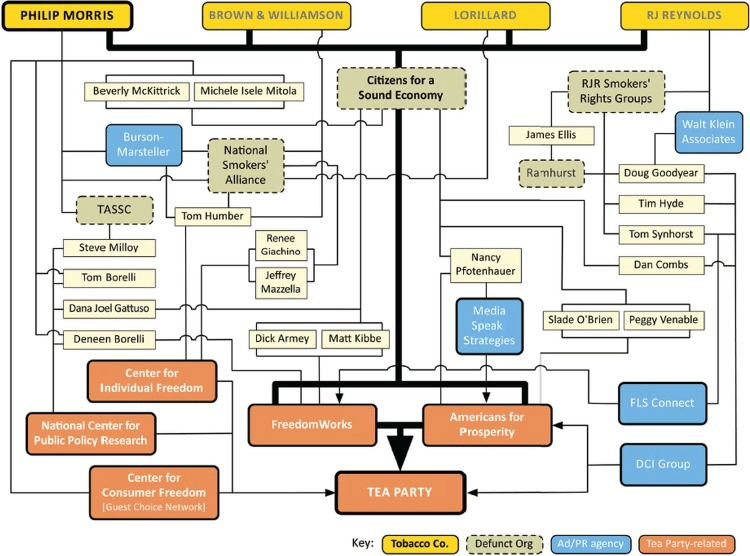
On course, this effort was just the latest incarnation of an even earlier network that the big cigarette companies built starting in the 1980s to oppose clean indoor air, tobacco taxes and other tobacco control policies. As diagrammed below, this network became the foundation for what later grew into the Tea Party.
And, of course, there is a similar pro-e-cig organization in Australia.
Some things never change.
 Stanton Glantz blog