Governments are increasingly responding to the rapid growth of youth e-cigarette use with policies that restrict use and marketing of e-cigarettes. Hanna Ollila and colleagues’ new paper, “Exclusive and dual use of electronic cigarettes among European youth in 32 countries with different regulatory landscapes” shows, based on 2019 data, that stronger regulation of e-cigarettes is associated with lower youth (age 15-16) use.
They found that in 2019 among EU youth, 12.4% currently used e-cigarettes (6.0% e-cigarettes only and 6.4% dual use with cigarettes). This result highlights the importance of dual use, which was the pattern for over half the youth e-cigarette users (6.4/12.4=52%), highlighting the importance of dual use, something e-cigarette advocates tend to ignore.
Current cigarette smoking was higher — 19.4% (13.0% cigarettes only; 6.4% dual users).
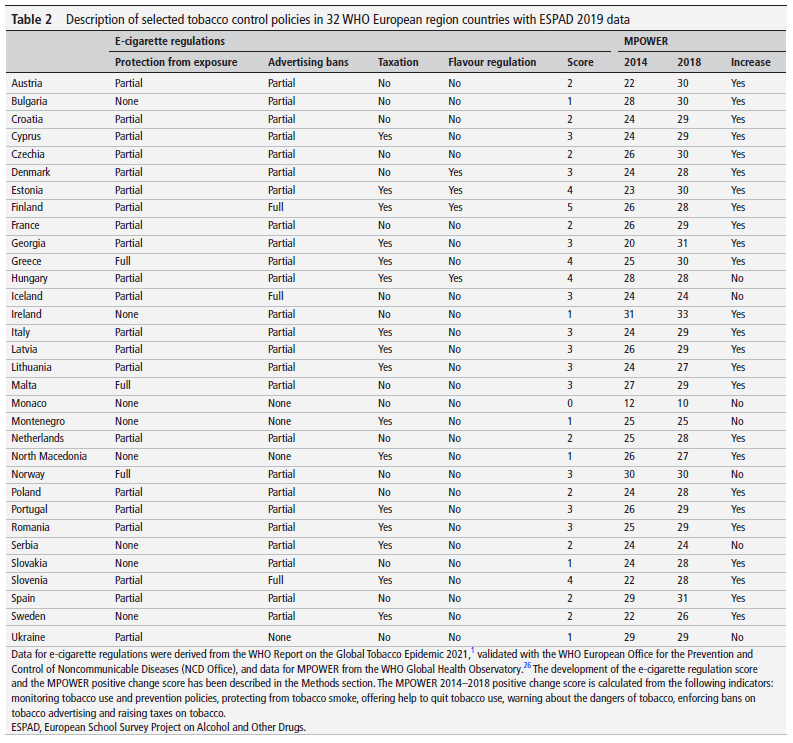
They scored e-cigarette regulations as follows, using MPOWER as a general framework:
- P (Protect from exposure): 2=full (all public indoor places completely covered by bans on e-cigarette use); 1=partial (3 types of public indoor places covered completely by bans of e-cigarette use); 0 = none
- E (Enforce bans on advertising): 2= full (ban on all forms of direct and indirect advertising of e-cigarettes); 1=partial (advertising ban at least on national television, radio and print media) or 0=none.
- R (raise taxes): 1=yes; 0 = no
- F (Flavor restrictions): 1=yes; 0 = no.
Each country received a score obtained by adding up the individual scores, resulting in a composite score between 6 (comprehensive strong regulation) and 0 (no regulation).
In 2019, Finland received the highest score (5); Estonia the lowest (0):
Controlling for a variety of demographic factors, each one point increase in composite country e-cigarette regulation score was associated with 20% lower odds of current e-cigarette use (current exclusive e-cigarette use: OR=0.78; 95% CI 0.65 to 0.94; current dual use: OR=0.80; 95% CI 0.67 to 0.95).
This suggests that a score of 5 (Finland) would be associated with an OR of about 0.32 for current e-cigarette use. Indeed, Ollila and colleagues note, “in Finland, where
e-cigarettes were subject to the same regulatory scheme as tobacco products in 2016—including retail sale licence, age limit, point-of-sale display and advertising ban, bans of e-cigarette use in smoke-free areas and ban on other than tobacco flavours in e-liquids, in addition to the pre-existing general advertising ban—the daily use of products has been decreasing steadily among youth.”
The bottom line: Applying the same restrictions on e-cigarettes as cigarettes lowers youth use.
Here is the abstract:
Background: The Tobacco Products Directive (2014/40/EU) partially harmonised the regulation of electronic cigarettes (e-cigarettes) in Europe, but individual countries maintain jurisdiction over bans on use in public places, domestic advertising, taxation and flavour regulations. Their association with youth e-cigarette use has not been examined.
Methods: We used the cross-sectional 2019 European School Survey Project on Alcohol and Other Drugs data from 32 countries with 98 758 students aged 15-16 years and the 2020 WHO’s assessment of the e-cigarette regulations. Multilevel logistic regression models on ever (vs never) and current (vs non-current) exclusive e-cigarette use, exclusive cigarette use and dual use by e-cigarette regulations’ composite score were adjusted for age, gender, parental education, perceived family’s financial well-being, perceived difficulty of obtaining cigarettes, country income level and general progress in tobacco control.
Results: Of the respondents, 13.3% had ever used cigarettes, 10.6% e-cigarettes and 27.3% both; 13.0% currently used cigarettes, 6.0% e-cigarettes and 6.4% both. Higher composite country score in the e-cigarette regulations was associated with lower current exclusive e-cigarette use (OR=0.78; 95% CI 0.65 to 0.94) and current dual use (OR=0.80; 95% CI 0.67 to 0.95). Youth perceiving more difficulties in obtaining cigarettes were less likely to use cigarettes, e-cigarettes and both ever and currently (OR from 0.80 (95% CI 0.76 to 0.85) to 0.94 (95% CI 0.92 to 0.96)).
Conclusions: More comprehensive e-cigarette regulations and enforcement of age-of-sale laws may be protective of e-cigarette and dual use among adolescents.
The full citation is: Ollila H, Tarasenko Y, Ciobanu A, Lebedeva E, Raitasalo K. Exclusive and dual use of electronic cigarettes among European youth in 32 countries with different regulatory landscapes. Tob Control. 2023 Apr 25:tc-2022-057749. doi: 10.1136/tc-2022-057749. Epub ahead of print. PMID: 37185883. It is available here.
 Stanton Glantz blog