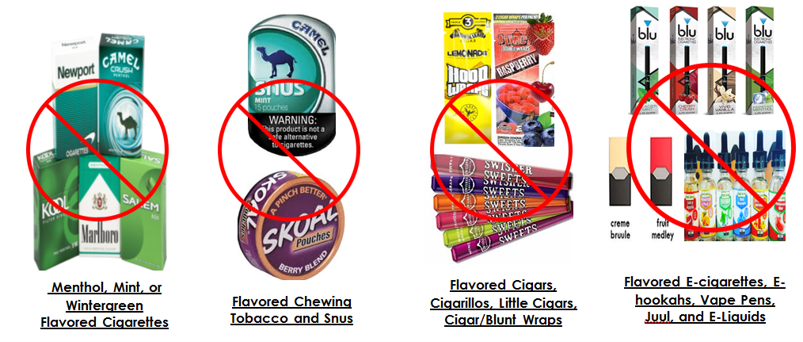
More and more states and localities are enacting bans or restrictions on the sale of flavored tobacco products. David Timberlake and colleague recently published “Variation in adults’ use of flavored tobacco products by sales restrictions in California jurisdictions” that uses data collected in California in 2019-2020 to show that comprehensive flavor sales bans are associated with 30% lower odds of adults consuming flavored tobacco products. There was no significant difference in the odds of adults consuming unflavored tobacco products.
In contrast, partial policies, defined as having exemptions pertaining to access (e.g., adult-only tobacco retailers), proximity (e.g., 500 ft. from schools), or exemption of a specific product (e.g. menthol), were not associated with significant changes in tobacco product use. This result is similar to research on the effects of clean indoor air laws on smoking, which show that comprehensive laws have the biggest effects.
While comprehensive bans were associated with drops in the odds of use of all products, the difference was only statistically significant for non-cigarette tobacco products (which includes cigars and little cigars). The lack of significance may reflect low power associated with small numbers of adult e-cigarette users.
There are three bottom lines from this study:
- Flavor bans reduce adult use of flavored tobacco products.
- There is not a compensating increase in adult use of non-flavored tobacco products.
- To be effective, the law has to be comprehensive.
The study did not include youth.
Here is the abstract:
Background: State and local policies prohibiting the sales of flavored tobacco have been effective in curtailing retail availability and sales of products across the United States. Less is known about the use of flavored tobacco which could vary as a function of type of ordinance, product category, policy implementation, and other factors.
Methods: The 2019-2020 California Health Interview Surveys were used to estimate flavored and non-flavored tobacco use among adults (n = 43,681) residing in a California jurisdiction with a comprehensive (n = 48), partial (n = 35), or no flavored tobacco sales restriction (FTSR) (n = 427). Multinomial logistic regression models, which accounted for clustering within jurisdictions (n = 510), were separately developed for outcomes corresponding to use of any tobacco, non-cigarette tobacco products (NCTPs), electronic nicotine delivery systems, and conventional cigarettes. Individual-level effects of policy on tobacco use were estimated due to the overlap between the survey periods and effective policy dates.
Results: Approximately 22% of Californians were subject to a partial or comprehensive FTSR by December 31, 2020. Accounting for potential confounders, residents of jurisdictions with a comprehensive FTSR (vs. no ban) had 30% lower odds of using any flavored tobacco. The strongest and only statistically significant association by product category was exposure to a comprehensive FTSR and use of a flavored NCTP (aOR=0.4 (0.2, 0.8); p=0.008). Null or positive associations were primarily observed between a partial FTSR and flavored tobacco use, as well as associations between any FTSR and non-flavored tobacco use.
Conclusion: Recent passage of a statewide ban in California will close gaps from the patchwork of local policies and eliminate most partial FTSR exemptions. However, state law still exempts the sales of some flavored tobacco products (e.g., hookah), leaving jurisdictions the option of enacting comprehensive FTSRs that may be more effective than partial FTSRs in reducing use of flavored tobacco.
The full citation is: Timberlake DS, Aviles J, Payán DD. Variation in adults’ use of flavored tobacco products by sales restrictions in California jurisdictions. Int J Drug Policy. 2023 Jun;116:104041. doi: 10.1016/j.drugpo.2023.104041. Epub 2023 Apr 27. PMID: 37119644. It is available here.
 Stanton Glantz blog