E-cigarette advocates, global warming deniers and social media companies continue to sidestep the implications of research showing dangers of their products by, among other things, retreating behind the high walls of claims that the evidence is not “causal.”
To put these claims in context, it is worth re-reading the last couple paragraphs from our book The Cigarette Papers (University of California Press, 1996, pages 441-442) on the original set of Brown and Williamson documents that were sent to me from “Mr. Butts” in 1994.
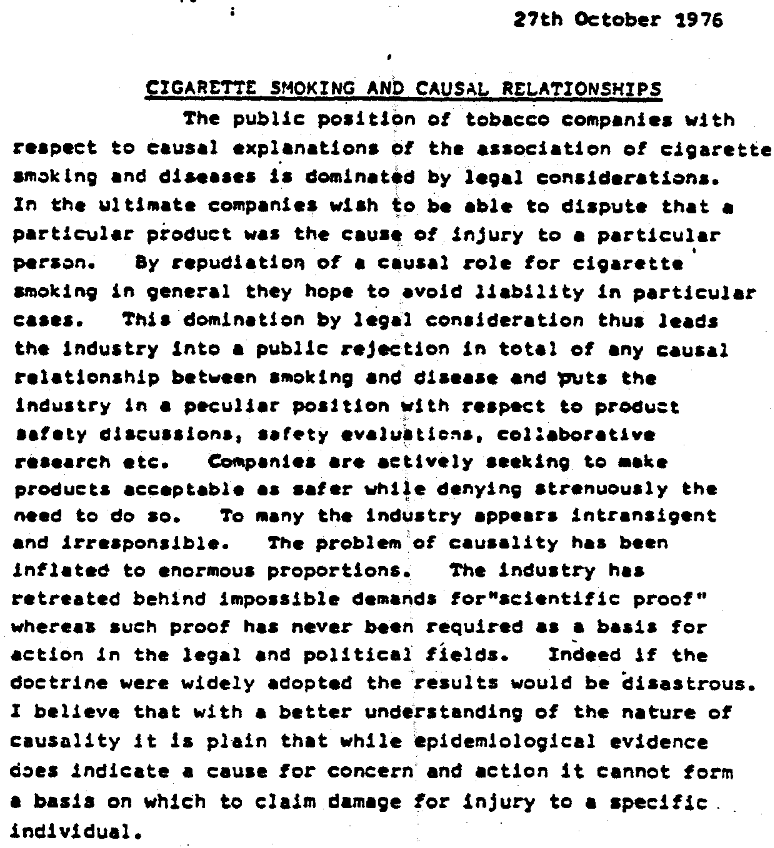
In 1976 Dr. S. J. Green, head of British American Tobacco (BAT) research and development and a member of the board of directors, wrote a thoughtful essay entitled “Cigarette Smoking and Causal Relationships,” which observes that the tobacco industry effectively manipulated the terms of debate in the scientific and legal communities in a way that led to an obsessive concern about “causality,” to the exclusion of common sense:
The public position of the tobacco companies with respect to causal explanations of the association of cigarette smoking and diseases is dominated by legal considerations. In the ultimate companies wish to be able to dispute that a particular product was the cause of injury to a particular person. By repudiation of a causal role for cigarette smoking in general they hope to avoid liability in particular cases. This domination by legal consideration thus leads the industry into a public rejection in total of any causal relationship between smoking and disease and puts the industry in a peculiar position with respect to product safety discussions, safety evaluations, collaborative research, etc. Companies are actively seeking to make products acceptable as safer while denying strenuously the need to do so. To many the industry appears intransigent and irresponsible. The problem of causality has been inflated to enormous proportions. The industry has retreated behind impossible demands for “scientific proof” whereas such proof has never been required as a basis for action in the legal and political fields. Indeed if the doctrine were widely adopted the results would be disastrous. I believe that with a better understanding of the nature of causality it is plain that while epidemiological evidence does indicate a cause for concern and action it cannot form a basis on which to claim damage for injury to a specific individual [emphasis added]. {BAT document 2231.08, p. 1}
Green concludes with an opinion that makes the very point upon which state lawsuits seeking recovery of medical care costs are based:
In summary, for social policy purposes it is sensible and totally relevant to use the experimental evidence pertaining to large groups and also to select the simplest hypothesis. It may therefore be concluded that for certain groups of people smoking causes the incidence of certain diseases to be higher than it would otherwise be [emphasis added]. {BAT document 2231.08, p. 4}
We should heed these words today.
The Cigarette Papers is available for free online here and as a book here.
 Stanton Glantz blog