The cigarette companies have introduced several generations of heated tobacco products (HTP) going back to the 1960s in the hope that generating the nicotine aerosol the consumer inhales by heating rather than burning the tobacco would lower risk by avoiding the toxic combustion products created by burning tobacco. None of these earlier products were successful in the marketplace.
Philip Morris International’s introduction of IQOS in 2014, followed by BAT’s glo and JTI’s Ploom are having more success. Like e-cigarettes, HTP the tobacco companies promote them as having lower risk than cigarettes and as a viable cessation device. Like cigarettes, e-cigarettes, and all their other products, the companies insist that they don’t want youth to use them.
Marco Scala and colleagues recently published “Patterns of Use of Heated Tobacco Products: A Comprehensive Systematic Review” in the Journal of Epidemiology that provides independent evidence on how the presence of HTP in the marketplace has interacted with cigarette smoking. What they found directly contradicts industry claims.
The searched the scientific literature in February 2022 and found including 71
cross-sectional studies and 5 cohort studies on HTP use that were conducted
between 2016 and 2022 in Asia (41 studies), Europe (22 studies), North America (15 studies), Oceania (3 studies), or Central America (2 studies).
Here are their key findings:
- The prevalence of HTP use increased substantially in the Japanese (annual percent change by 2.1% per year between 2015 and 2020) and the Italian general adult population (1.0% per year between 2016 and 2020; Figure 1). There were not substantial increases in the US, likely because FDA did not authorize sale of IQOS in the US until 2019.
- HTP users were more likely younger and male.
- Among 17 studies on teenagers, estimates of ever HTP use ranged from 0.7% in the United States (2019–2020) to 11.3% in Guatemala (2019) and estimates of current HTP use from 0.2% in the United States (2019–2020) to 2.9% in Guatemala (2019).
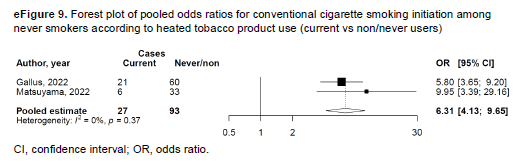
- Like e-cigarettes, HTP are a gateway to cigarettes for youth who start with them.
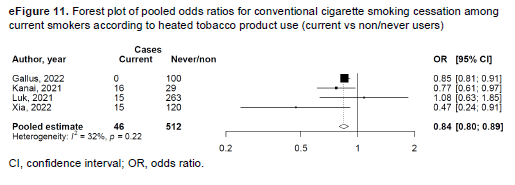
- Rather than promoting smoking cessation, HTPs keep people smoking. All 7 studies conducted on cigarette smokers (4 cohort studies and 3 cross-sectional) showed negative results for cessation. Among the 4 studies that could pooled in a meta-analysis, current cigarette smokers using HTPs were less likely to quit (OR 0.84; 95% CI, 0.80-0.89; chart at top of this blog post).
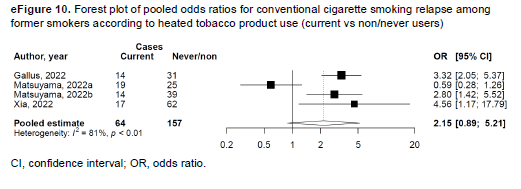
- While not quite reaching statistical significance, former smokers who used HTP appeared more likely to relapse (P=0.10):
- Not surprisingly, 68.3% of HTP users were dual users (95% CI, 58.6–76.7%).
- Consistent with this finding, a study conducted in 11 European countries showed that half of the former smokers using HTPs had quit smoking before HTPs were launched in their local markets, indicating that a large proportion of former smokers using HTPs are not smokers who switched to HTPs to reduce their harm, but people who had already quit smoking and started using a tobacco product again with the entrance in commerce of HTPs.
The bottom line: Like e-cigarettes, HTP help tobacco companies expand and maintain their markets, including their cigarette markets.
The authors sum up the paper and its implications clearly:
[O]ur systematic review shows robust evidence of
frequent use of HTPs among current smokers, who continue smoking conventional cigarettes, and among younger individuals and adolescents. The widespread use of HTPs among young people contradicts tobacco companies’ claims that these devices are designed only for heavy smokers, and confirms that the growing spread of HTP use represents a severe public health issue.
Here is the abstract:
Introduction: Relative or absolute safety of heated tobacco products (HTPs) remains unknown, while independent literature suggests that these products do not favor tobacco control. We conducted a comprehensive systematic review and meta-analysis to evaluate HTP usage patterns and the effect of HTP use on conventional tobacco smoking (use transitions).
Methods: We used Pubmed/MEDLINE, Embase, and the Cochrane Library to identify all articles published up to February 2022 on HTP use. For the present review, we included all representative cross-sectional studies dealing with HTP use, and all prospective cohort studies or cross-sectional studies on conventional tobacco smoking transitions due to HTP use. From 610 non-duplicate articles, 76 were eligible (71 cross-sectional and 5 prospective cohort studies).
Results: Compared with young adults, HTP use was less frequent among middle-aged (15 studies; pooled odds ratio [OR] 0.59; 95% confidence interval [CI], 0.48-0.74) and older adults (12 studies; OR 0.17; 95% CI, 0.07-0.38). HTP use was more frequent among former (6 studies; OR 2.73; 95% CI, 1.03-7.25) and current smokers (12 studies; OR 14.53; 95% CI, 6.34-33.31). Overall, 68.3% of HTP users were dual users (n = 26). Eight studies (including 5 cohorts) showed that HTP users were more likely than non-users to start conventional cigarette smoking (2 studies; OR 6.31; 95% CI, 4.13-9.65), whereas current cigarette smokers using HTPs were less likely to quit (4 studies; OR 0.84; 95% CI, 0.80-0.89).
Conclusion: We found that HTPs are specifically popular among young generations. More than two out of three HTP users are dual users. Prospective studies consistently show that, in real life, HTPs are not effective smoking-cessation tools.
The full citation is: Scala M, Dallera G, Gorini G, Achille J, Havermans A, Neto C, Odone A, Smits L, Zambon A, Lugo A, Gallus S. Patterns of Use of Heated Tobacco Products: A Comprehensive Systematic Review. J Epidemiol. 2025 May 5;35(5):213-221. doi: 10.2188/jea.JE20240189. Epub 2025 Mar 31. PMID: 39805598; PMCID: PMC11979348. It is available here.
 Stanton Glantz blog