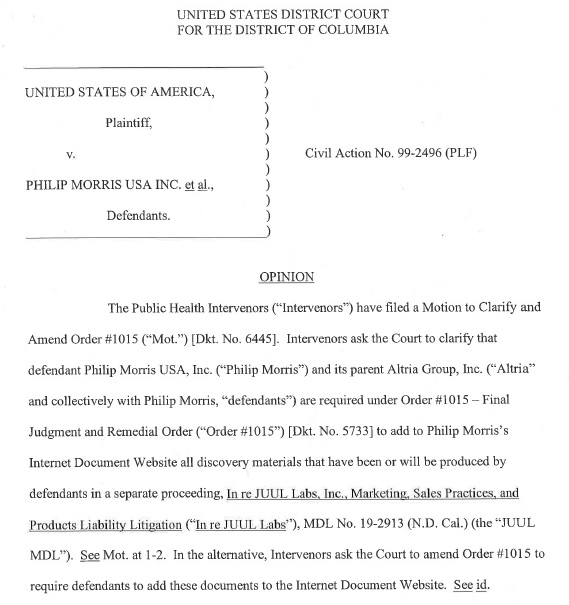
Thanks to the efforts of the public health intervenors led by the Campaign for Tobacco Free Kids, Judge Paul Friedman has ordered Philip Morris to make 875,000 documents produced in the multi-party litigation against Juul public under the document disclosure provisions of the federal Racketeer Influenced and Corrupt Organization case against the big cigarette companies.
Judge Friedman took over supervising the implementation of the RICO order after Judge Gladys Kessler retired. That order required defendant companies, including Philip Morris, to make documents produced in other subsequent smoking and health litigation public.
Philip Morris had argued that the RICO ruling did not apply because the RICO case was about cigarettes, not e-cigarettes. Judge Friedman found that the RICO ruling still applied because of three “striking similarities” in Philip Morris’ behavior regarding Juul and its earlier behavior regarding cigarettes. As his ruling detailed:
| Juul plaintiff allegations | Judge Kessler’s RICO ruling |
| Philip Morris and Altria helped direct the “nicotine content misrepresentation scheme,” causing “thousands, if not millions, of JUUL pod packages to be distributed to consumers with false and misleading information regarding [their] nicotine content.” | defendents [including PM] “publicly, vehemently, and repeatedly denied the addictiveness of smoking and nicotine’s central role in smoking” and “designed their cigarettes to precisely control nicotine delivery levels and provide doses of nicotine sufficient to create and sustain addiction.” … Defendants “maintain[ed] that neither smoking nor nicotine [was] addictive” despite knowing that such a statement was false and “manipulat[ed] the design of cigarettes and the delivery of nicotine to smokers” while denying that they were doing so. |
| JUUL defendants, through the “flavor preservation scheme,” worked to “prevent regulation that would have impeded their plan to keep selling to children” and “to ensure that the FDA allowed JUUL’s mint flavor to remain on the market.” … Defendants “knowingly and intentionally marketed [JUUL devices” to youth users.” | [RICO defendants] falsely denied that they marketed to youth “while engaging in such marketing and advertising with the intent of addicting young people and enticing them t become lifelong smokers.” … defendants marketed to young people, knowing that they “were highly susceptible to marketing and advertising appeals, would underestimate the health risks and effects of smoking, [and] would overestimate their ability to stop smoking.” |
| plaintiffs allege that Philip Morris and Altria participated in a “cover up scheme” in which they adopted a marketing campaign “to mislead consumers into thinking [JUUL devices] were benign smoking cessation devices, even though [they were never’ designed to break addictions. … Altria “transmitted false and misleading communications to the public and the federal government, including Congress and the FDA, in an attempt to stave off regulation of the JUUL product.” | defendants engaged in “deceptive marketing and cigarette design modifications [that] exploit[ed] smokers’ desire for less hazerdous ‘low tar’ cigarettes which Defendants knew to be no safer than full-flavor cigarettes.” … defendants “extensively — and successfully — marketed and promoted their low tar/light cigarettes as less harmful alternatives to full-flavor cigarettes.” |
This clear comparison highlights how, despite its claims to the contrary, Philip Morris has not changed.
This is a very important decision that will help the public and public health researchers and policymakers understand how the tobacco companies tactics have evolved as they develop and promote new products to create and maintain nicotine addiction.
I am, however, concerned that the order did not impose a specific timetable for making the documents public. It’s been over two years since North Carolina settled its lawsuit against Juul, which called for release of the Juul documents produced in discovery over the next year. Now, two years later no documents are public.
The North Carolina settlement agreement (paragraph 35b) said the documents would be made available within a year:
Within twelve (12) months of the Effective Date [June 28, 2021), JLI shall identify every document it seeks to redact or withhold and identify the category that forms the basis for redaction or withholding .JLI shall identify the first set of documents within three (3) months of the Effective Date, and continue to identify the remaining documents on the rolling basis through the end of the twelve (12) month period.
But none of these documents have been made public through a public depository. (Once they are released UCSF plans to integrate them into the Truth Tobacco Industry Documents Library.)
As I pointed out a year ago (July 2022), North Carolina and Juul may have been fighting over redactions in specific documents (discussed later in the agreement). Nevertheless, it’s hard to believe that none of the documents could be released by now.
It is time for NC Attorney General Josh Stein to give the public a briefing on where things are in the process and when the documents will finally be disclosed.
The NC experience also underlines the importance that the public health intervenors in the federal RICO case and Department of Justice monitor the speed with which Philip Morris complies with Judge Friedman’s order and be ready to go back to court if Philip Morris does not release the documents in a reasonable time.
 Stanton Glantz blog